



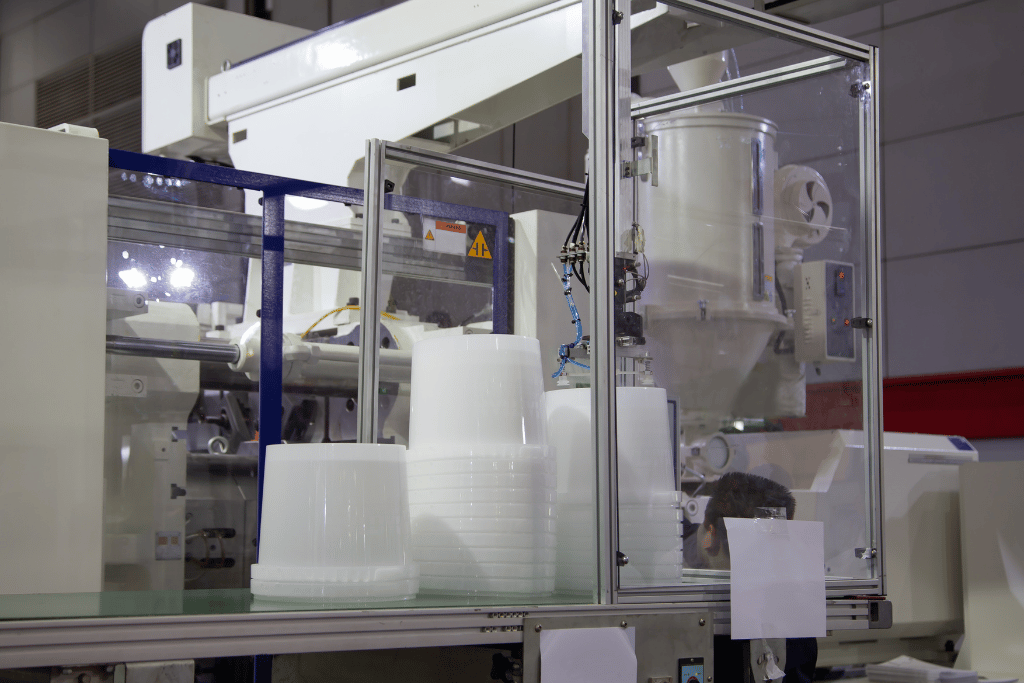
Determining whether a part should be molded from a single resin or combine multiple materials is a critical decision early in product design. Single-material molding excels at simplicity and cost control, while multi-material molding unlocks added functionality, aesthetics, and performance. For plastic injection molding companies, understanding the trade-offs ensures optimized tooling, efficient production, and the best end-use properties.
Single-Material Molding Overview
In single-material molding, one resin flows into the mold cavity, cools, and forms the final part. This approach offers several advantages:
- Simplicity of Tooling and Process Control
A single feedthroat, one barrel, and a uniform melt allow straightforward machine setup. Temperature, pressure, and cooling parameters remain constant, minimizing process variation. Tooling remains less complex since the mold requires only one material delivery channel. - Lower Upfront Costs
Because only one material is needed, resin purchasing and inventory management are simpler. Molds for single-material parts lack slide-in cores or rotating platens required for additional materials, reducing tool-build time and cost. - Ease of Validation and Quality Assurance
Validation focuses on one set of material properties. Sampling and testing (tensile, impact, dimensional) proceed with a single resin lot. Regulatory approvals, especially in medical or aerospace applications, experience fewer hurdles because only one material’s traceability and certifications must be documented.
However, single-material molding cannot combine disparate material properties in a single cycle. Part designers must often add secondary operations like insert assembly, ultrasonic welding, and painting, which increase cycle time and assembly labor.
Multi-Material Molding Overview
Multi-material molding, sometimes called two-shot or overmolding, injects one resin into the mold, then immediately injects a second resin onto or around the first. This approach unlocks the following benefits:
- Enhanced Functionality in One Piece
Soft-touch grips over a rigid core, rigid mounting bosses embedded in an elastic seal, or rigid structural ribs filled with fiber-reinforced resin all form in one operation. Designers achieve combinations of hardness, flexibility, color, or even conductivity without glue or fasteners. - Reduced Assembly Steps
Overmolding separate components together eliminates fixtures, manual assembly, and post-mold bonding. This saves labor, reduces error potential, and lowers total cost of ownership, especially at higher volumes. - Distinct Aesthetic and Ergonomic Options
Two or more colors can form crisp boundaries where one material transitions to another. TPE overmolds add comfort in handheld devices, while rigid bases maintain structural integrity. Branding, labeling, and soft-touch features come molded in rather than applied later.
Multi-material molding often requires specialized tooling like rotary platens or slide mechanisms to move the partially molded component between injection stages. It also demands precise process control so the first resin does not overcool before the second shot, ensuring chemical bonding at the interface. These complexities raise upfront tool investment and lengthen initial validation.
Factors to Consider When Choosing
- End-Use Performance Requirements
If the part only needs uniform mechanical strength, single-material molding usually suffices. But when a component must combine rigid load-bearing sections with flexible seals, multi-material molding avoids compromises in performance. For example, a medical hand-held device might require a rigid structural core plus a soft overmold for grip and patient comfort. - Cost and Volume Projections
For high annual volumes, tens or hundreds of thousands, multi-material molding often pays off despite higher tooling costs. Eliminating secondary assembly and handling labor offsets the initial investment. Conversely, low-volume runs or simple geometry parts favor single-material tooling to minimize fixed costs. - Tooling Complexity and Lead Time
Single-material molds have simpler cores, fewer moving parts, and no need to index between shots. They often achieve first-article results in weeks rather than months. Multi-material molds require additional engineering like rotary mechanisms, shut-offs, and precise cooling profiles, extending lead times and validation cycles. When speed to market is critical, single-material molding may win. - Material Compatibility and Bonding
Not every resin pair bonds reliably. Engineers must verify that the first shot’s partially solidified resin remains within a temperature window where the second resin chemically bonds. Material data sheets, small-scale trials, and Moldflow simulations guide selection. Common pairings include TPE bonded to rigid polypropylene or polycarbonate over a crystalline nylon core, but custom blends sometimes demand specialized tie-layers. - Regulatory and Quality Considerations
Single-material parts require one material qualification package—traceability, biocompatibility, flammability ratings, or food-contact certifications. Multi-material parts need separate documentation for each resin, as well as validation of the bond interface. In medical or aerospace industries, this can add rounds of testing and audits. Close collaboration between design teams and plastic injection molding companies ensures that compliance requirements are met without excessive rework. - Lifecycle and Maintenance
Overmolded parts typically demonstrate enhanced durability, like soft seals remain bonded to rigid substrates even under dynamic loads. However, if long-term repairability or recyclability matters, single-material parts may be simpler to disassemble or recycle at end-of-life. Multi-material composites can complicate recycling streams unless designed with compatible resins.
Case Examples
- Consumer Electronics Connector
A compact headphone jack required both a rigid structural housing and a soft, rubberized gasket to meet ingress-protection ratings. Single-material molding would necessitate a separate assembly of a gasket and plastic housing. Engineers selected a two-shot process: first shot of high-impact polycarbonate formed the housing; second shot of thermoplastic elastomer overmolded the seal. This achieved IPX7 water resistance in one cycle and eliminated assembly labor. - Automotive Sensor Cover
A drivetrain sensor cover needed a glass-filled nylon core for structural stability and a soft TPE lip for vibration damping. Single-material molding required separate compression molding of the lip and subsequent adhesive bonding to the housing, which adds cycle time and potential leak paths. A two-shot mold allowed nylon core injection, followed by TPE overmolding without manual handling. This approach reduced cycle time by 12 seconds per part and improved bond reliability in field testing.
Choosing between single-material molding and multi-material molding hinges on a clear understanding of performance needs, budget constraints, tool-build complexity, and regulatory requirements. Single-material molding offers simplicity, rapid validation, and lower upfront costs, making them ideal for parts requiring uniform mechanical properties or low to mid volumes. Multi-material molding delivers advanced functionality, integrated features, and assembly savings, which are best suited to high volumes or components demanding distinct material properties in a single structure.
For tailored guidance, collaborate with experienced plastic injection molding companies. By analyzing part geometry, load conditions, regulatory mandates, and production forecasts, they can recommend the optimal approach, ensuring robust performance, cost efficiency, and a smooth path from design to production. To discuss single-material versus multi-material strategies for your next program, contact Hansen Plastics Corporation for expert consultation and turnkey molding solutions.