



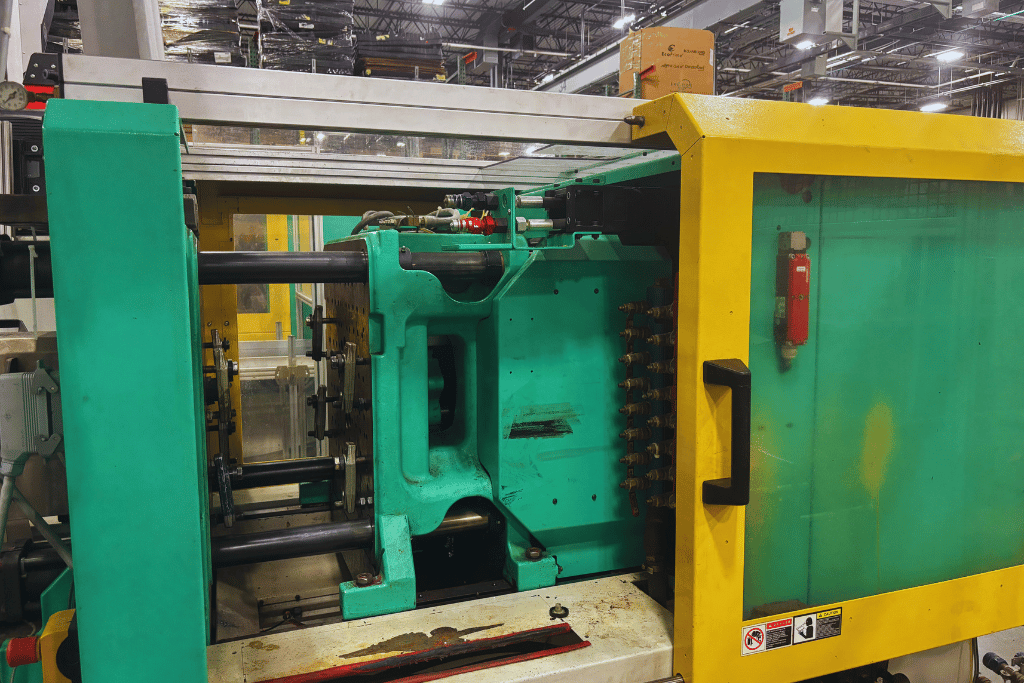
Selecting the right injection molding process impacts part quality, production efficiency, and overall cost. While both horizontal and vertical presses can produce high quality plastic parts, they excel in different scenarios. This guide compares horizontal vs vertical injection molding so you can choose the best approach based on part geometry, insert requirements, automation needs, and production volume.
Horizontal vs Vertical Injection Molding at a Glance
Here’s a quick comparison before we go deeper:
- Horizontal presses are commonly used for high volume production and automated workflows, especially when parts do not require frequent insert placement.
- Vertical presses are often preferred for insert molding applications and parts that benefit from easier insert placement and stable positioning.
If your project includes embedded metal components, threaded inserts, or assemblies that would otherwise require secondary operations, you may want to review our Vertical Insert Molding Solutions page.
How Horizontal Injection Molding Works
Horizontal injection molding uses a press where the mold opens left-to-right. This configuration is widely used across industries and supports fast, repeatable cycles, especially in automated production environments.
Common strengths of horizontal presses
- Efficient for high volume programs
- Supports a wide range of tooling styles and automation
- Well suited for parts with consistent demolding requirements
- Often ideal for multi-cavity tools when scaling output
Common considerations
- Insert placement can be less efficient depending on part and tooling design
- Part ejection, gravity, and handling may require additional automation tuning for certain geometries
How Vertical Injection Molding Works
Vertical injection molding uses a press where the mold opens top-to-bottom. This setup is frequently used for insert molding because it can make insert placement simpler and more stable before injection.
Common strengths of vertical presses
- Often preferred for insert molding workflows
- Insert placement can be easier for manual or semi-automated setups
- Good for parts where stable positioning during molding is critical
- Can reduce secondary assembly steps when inserts are molded in place
Common considerations
- Depending on part design, automation and cycle strategies can differ from horizontal setups
- Tooling and handling may need to be optimized around insert placement requirements
Key Differences: Horizontal vs Vertical Injection Molding
Below are the main factors manufacturers use to decide which approach fits best.
1) Insert requirements
If your part requires embedded components (metal inserts, threaded inserts, bushings, or similar hardware), vertical presses are commonly used because they support consistent insert placement and can reduce assembly steps.
If your part has no inserts and is produced at higher volumes, horizontal presses are often the default choice due to widespread automation patterns and throughput.
2) Part geometry and handling
Some part shapes are easier to load, support, and demold in one configuration than the other. The best choice depends on how the part sits in the tool and how it will be removed consistently without deformation.
3) Production volume and automation
Horizontal presses are commonly selected for high volume programs that rely heavily on automated part handling, robotics, and conveyorized workflows.
Vertical presses are often used when insert placement and part stability are key drivers, including situations where a manual or hybrid workflow is more practical than full automation.
4) Tooling approach and cost considerations
Tooling cost is not only about press orientation. It also depends on:
- Part design complexity
- Number of cavities
- Insert placement strategy (if applicable)
- Material requirements
- Quality and inspection requirements
A good next step is to align your process choice with the full production plan, not just the press orientation.
Which Process Should You Choose?
Here are simple guidelines that often help:
Choose horizontal injection molding when:
- Your part does not require inserts
- You need high throughput and repeatability at scale
- Automation and multi-cavity tooling are priorities
Choose vertical injection molding when:
- Your part requires embedded inserts or components
- Reducing secondary assembly is a major goal
- Consistent insert placement and stability are key requirements
Common Questions
Is vertical injection molding the same as insert molding?
Not exactly. Insert molding describes molding plastic around an insert. Vertical presses are commonly used for insert molding, but the terms are not identical.
Can I use either process for the same part?
Sometimes, yes. Many parts can be produced on either configuration depending on tooling design and production strategy. The best choice depends on inserts, geometry, volume, and automation needs.
What if I’m not sure which approach is best?
If you share your part requirements, expected volumes, and whether inserts are needed, a molding partner can recommend the most efficient approach.
Next Step: If Your Project Requires Insert Molding
If your part requires embedded hardware or you want to reduce assembly steps, vertical insert molding may be the best fit.
Learn more here:
Vertical Insert Molding Solutions