



In today’s fast-paced manufacturing environment, speed to market can determine whether a product launch succeeds or stalls. Yet one of the most common bottlenecks in new product development is the gap between prototype approval and the start of actual production.
Manufacturers face a familiar set of challenges during this critical phase:
- Long lead times for hardened production molds — sometimes stretching 16 to 24 weeks
- Late-stage design changes that demand injection molding tooling modifications
- Intense pressure from stakeholders and market windows to launch quickly
- Uncertainty about demand volumes before committing to expensive tooling
Bridge tooling offers a practical solution to this problem. Rather than waiting months for full production tooling to be ready, bridge tooling enables manufacturers to start limited production earlier, validate critical process parameters, and accelerate the transition to full-scale output.
This article explores what bridge tooling is, why it matters, and how to use it strategically within an injection molding workflow.
What Is Bridge Tooling in Injection Molding?
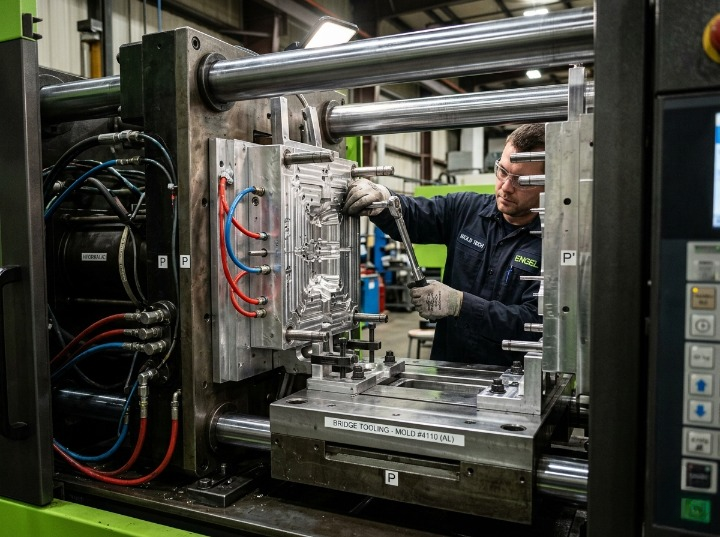
Bridge tooling refers to a transitional mold — typically made from aluminum or semi-hardened steel – used to produce real injection-molded parts after prototyping but before a full production mold is commissioned.
It “bridges” the gap between two phases of a product’s development lifecycle:
- Prototype Tooling: Low-volume, exploratory, often made from softer materials or via 3D printing. Used to verify form and fit, not intended for real-world production.
- Production Tooling: Hardened steel, built for high-volume output. Long lead times and high upfront costs.
Bridge tooling sits in the middle – capable enough to produce production-quality parts at limited volumes, fast enough to deliver before the production mold is finished.
| Prototype Tooling | Bridge Tooling |
| Soft material (RTV, resin, or prototype-grade aluminum) | Production-grade aluminum or semi-hardened steel |
| Low shot counts (dozens to hundreds) | Medium shot counts (hundreds to thousands) |
| Form/fit/function verification | Real production parts with near-production quality |
| Not intended for real production use | Enables process validation and early revenue |
Why Production Start Gets Delayed?
Understanding why production timelines slip is the first step toward solving the problem. The most common causes include:
Long Lead Times for Hardened Steel Molds
Production-grade steel molds often require 16 to 24 weeks to design, machine, and qualify. For products with tight market windows, this timeline is simply too long.
Late-Stage Design Changes
Even after prototype approval, injection mold design engineers often make refinements when early production parts reveal issues with aesthetics, assembly, or performance. Each change can push tooling timelines further.
Waiting for Tooling Approval Cycles
Production tooling must pass rigorous qualification processes (often T1, T2, T3 approval stages). Each cycle adds weeks. Any defects found during qualification restart the clock.
Uncertainty in Demand or Scaling
Before a product proves itself in the market, committing to expensive high-volume injection molding tooling can feel premature. Organizations may delay the decision, creating a production vacuum.
Risk of Committing Too Early
Locking in a final design and investing in hardened tooling before real-world validation carries significant risk. If changes are needed post-production, the cost of modifying a hardened steel mold can be prohibitive.
Every week of delay in production start can mean lost revenue, missed market windows, and competitor advantage. Bridge tooling addresses multiple delay causes simultaneously.
How Bridge Tooling Supports Faster Production Start?
Bridge tooling compresses the timeline between design finalization and the first shipment of parts. Here’s how it actively supports faster production start:
Enables Early Part Production
Rather than waiting for production tooling to be completed, bridge tooling can be fabricated in 4 to 8 weeks and used to start producing real parts immediately. This is especially critical when customer commitments or product launches cannot wait.
Supports Parallel Processes
Bridge tooling allows production and validation to happen simultaneously. While bridge molds are running parts for initial orders, engineers can refine the injection mold design and finalize production tooling specs – reducing idle time between phases.
Reduces Stage-to-Stage Downtime
In traditional workflows, teams wait for production tooling approval before beginning any process setup. Bridge tooling eliminates this waiting period and keeps the production line active.
Validates Materials, Machine Settings, and Cycle Times
Because bridge tooling uses production-grade materials and processes, it generates real-world data on:
- Optimal material selection and behavior under process conditions
- Machine parameters including temperature, pressure, and cycle time
- Mold cooling performance and part ejection reliability
This data becomes the foundation for setting up production tooling correctly the first time.
Accelerates the Transition to Full-Scale Production
By the time production tooling is ready, your team already has validated process data, trained operators, and an established quality baseline. The scale-up is smoother, faster, and less risky.
When Bridge Tooling Makes Sense?
Bridge tooling is not a universal solution, but it is the right tool in several common scenarios:
- Tight product launch timelines – market windows, trade shows, or customer commitments demand early part availability
- Design mostly finalized but needs real-world validation before final injection molding tooling investment
- Medium-volume initial demand where full production tooling may be cost-excessive at launch
- Complex parts requiring process validation to ensure quality before committing to hardened molds
- When production delay creates direct business risk – contractual penalties, revenue loss, or competitive disadvantage
Bridge tooling is particularly valuable in industries such as medical devices, consumer electronics, and automotive components where regulatory approvals or market timing create non-negotiable launch deadlines.
Key Benefits for Manufacturers
When applied strategically, bridge tooling delivers meaningful advantages across the production lifecycle:
| Benefits | What It Means in Practice |
| Faster Time-to-Market | Begin production weeks or months earlier, meeting launch deadlines that production tooling cannot accommodate. |
| Reduced Lead Time Gap | Bridge tooling lead times of 4–8 weeks vs. 16–24 weeks for production molds close the timeline gap significantly. |
| Lower Initial Investment Risk | Aluminum and semi-hardened steel tools cost significantly less than hardened production molds, reducing upfront capital exposure. |
| Better Part Quality at Scale-Up | Process insights gained from bridge tooling runs translate directly into higher first-pass quality when production tooling launches. |
| Early Revenue Opportunity | Limited production runs from bridge tooling can begin generating revenue before the full production mold is complete. |
Practical Considerations Before Using Bridge Tooling
Bridge tooling works best when it is planned intentionally rather than used reactively. Before commissioning a bridge tool, consider the following:
Choose the Right Injection Molding Tooling Material
The tooling material should match your volume requirements and expected shot count. Aluminum tools offer the fastest lead times and lowest cost, but are limited to lower shot counts and may not support all surface finish requirements. Semi-hardened steel (such as P20 steel) offers greater durability for medium-volume bridge applications.
Work with Experienced Injection Mold Designers
Bridge tooling requires injection mold designers who understand both the constraints of bridge materials and the requirements of the eventual production mold. The bridge tool should be designed with the production tool in mind, ensuring that insights transfer cleanly to the final design.
Use Near-Production Conditions for Testing
To get reliable data from bridge tooling runs, it is essential to use production-grade materials, the same injection molding machine class, and target processing parameters. Testing with different resins or machines reduces the validity of the data collected.
Plan Data Collection and Transfer
Define in advance what data will be collected from bridge tooling runs (cycle times, defect rates, material behavior, cooling performance) and how that data will inform the final tooling design. Without a structured data transfer plan, the learnings from bridge tooling may not be fully utilized.
Planning the Transition to Production Tooling
Bridge tooling is a step, not a destination. Planning the transition to full production tooling from the start ensures that bridge tooling runs generate maximum value.
Identify Your Transition Trigger
Decide in advance what conditions will prompt the move to production tooling. This might be a volume threshold, a design approval milestone, or a specific market event. Without a defined trigger, bridge tooling can become a default mode of operation longer than intended.
Avoid Duplication of Effort
Bridge tooling and production tooling development should be coordinated, not sequential in isolation. Production tooling design should begin in parallel with bridge tooling runs so that findings are incorporated in real time.
Use Bridge Tooling Insights to Finalize Injection Mold Design
Every process change made during bridge tooling runs — gating adjustments, cooling modifications, ejector pin placements — should be documented and incorporated into the production tool design. This “first time right” approach to production tooling reduces T1 and T2 qualification cycles significantly.
Ensure Smooth Scale-Up Without Disruption
When transitioning from bridge to production tooling, maintain process documentation, operator training records, and quality control baselines. A well-managed transition means production ramp-up happens without a quality dip or schedule delay.
Simple Decision Framework
Not every project needs bridge tooling. Use this framework to determine whether bridge tooling is the right choice for your current situation:
| Factor | Choose Bridge Tooling | Choose Production Tooling |
| Timeline | Launch urgency is high | Schedule allows for full lead time |
| Design Stability | Minor tweaks still expected | Design is fully finalized |
| Volume | Low to medium initial run | High-volume, proven demand |
| Budget | Lower upfront investment | Ready for full capital commitment |
| Risk Level | Need process validation | Process is already well-understood |
Remember: Bridge tooling is a speed-first approach — it is not a replacement for production tooling but a deliberate step toward production readiness. Use it when time, validation, and early revenue matter more than long-term unit cost optimization.
Move to Production Faster with the Right Injection Molding Tooling Strategy
The pressure to launch quickly is real, and the cost of waiting is tangible. Bridge tooling is one of the most practical tools available to manufacturers who need to compress the time between design approval and market delivery.
By enabling limited production before final tooling is ready, bridge tooling allows manufacturers to:
- Start generating revenue earlier
- Reduce the risk of expensive production tooling rework
- Validate materials, process settings, and design decisions in real-world conditions
- Accelerate the transition to full-scale production with confidence
The key is treating bridge tooling as a strategic investment rather than an emergency measure. When planned carefully and executed with experienced partners, it becomes a competitive advantage in product launches.
Efficient injection molding production starts with smart tooling decisions. Bridge tooling is one such decision – one that keeps your project moving, your team informed, and your customers satisfied.
Ready to Accelerate Your Production Timeline?
Work with experienced injection molding tooling partners who understand bridge tooling strategy. The right team helps you validate faster, launch sooner, and scale confidently.
Contact an Expert Tooling Partner Today!
Frequently Asked Questions
Bridge tooling is a temporary mold used between prototype and full production. It allows manufacturers to start producing parts before final production molds are ready. In injection molding tooling, it helps reduce delays and keeps production moving while final injection molding tooling is still being built.
Prototype tooling is used to test and validate a design. It is not made for production use. Bridge tooling, on the other hand, is used to produce real parts in small to medium volumes. It also helps test manufacturing conditions, which makes it closer to production compared to prototype tooling.
Yes, bridge tooling helps reduce risks by allowing real-world testing before full production begins. Manufacturers can check materials, machine settings, and part quality early. This helps avoid costly mistakes when moving to full-scale production.
Bridge tooling is useful when timelines are tight and production cannot wait for final molds. It works best when the design is mostly ready but still needs testing under real production conditions.
No, bridge tooling is not designed for long-term or high-volume use. It is meant for short-term production. For large-scale manufacturing, full production tooling made from hardened steel is required.