



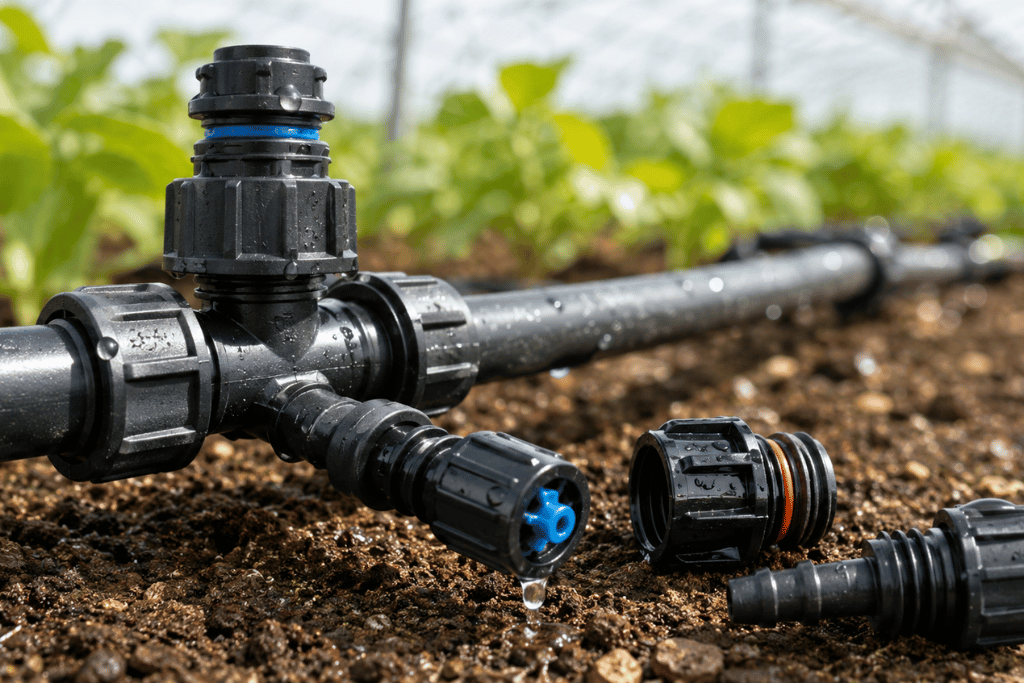
Drip irrigation systems are supposed to be boring. Quiet. Reliable. Set it and forget it. But when a fitting cracks or a connection starts leaking, the fallout is not small. You lose pressure, zones stop delivering evenly, plants get stressed, and suddenly a “tiny plastic part” becomes a field labor and downtime problem.
The truth is that most failures in drip irrigation plastic components come from the same few root causes: stress concentration, poor sealing surfaces, the wrong material for the environment, UV degradation, chemical exposure, and inconsistent fit over time. The good news is that these are predictable, and preventable, if you design and source with real conditions in mind.
This guide breaks down how cracking and leaks happen and what to do about them.
Why drip irrigation components fail in the field
Many drip irrigation components live in a tough mix of exposure and stress:
- Daily temperature swings
- UV exposure for above-ground sections
- Fertigation chemicals, pesticides, and cleaning agents
- Pressure cycling and water hammer events
- Dirt, grit, abrasion, and rough handling during installation
A component might pass initial pressure tests and still fail after a season because the material becomes brittle, small stresses grow into cracks, or seals deform and lose compression.
When you’re aiming for long-term reliability, the real target is not “it works today.” It’s “it stays stable under cycling, exposure, and handling.”
Cracking: the most common causes and how to reduce them
Stress points and stress concentration
Cracks almost always start at predictable locations: sharp corners, thin-to-thick transitions, threads, and areas around barbs or clamps where force concentrates.
If your component includes threaded features, snap fits, barbs, or clamp interfaces, your design should prioritize:
- smooth transitions with fillets instead of sharp internal corners
- consistent wall thickness to reduce shrink stress and warpage
- reinforcement where clamp load or torque is applied
- avoiding overly thin sections near stress-heavy features
Even small geometry changes here can drastically improve fatigue life.
Environmental stress cracking
This is the sneaky one. A part may be mechanically “strong enough,” and it may be “chemically compatible” in a general sense, but chemical exposure combined with stress can trigger cracking over time.
In drip irrigation systems, chemical exposure might include:
- fertilizer concentrates and nutrient blends
- pesticides and herbicides
- chlorinated water or disinfectants (depending on the system)
- cleaners used during maintenance
If cracking is happening near threads, barbs, or any area under load, environmental stress cracking should be on the suspect list. The fix usually involves material selection plus geometry improvements that reduce stress concentration.
UV degradation
UV does not just fade plastic. Over time it can reduce toughness and make parts brittle. Above-ground components, greenhouse zones with direct sunlight, and exposed fittings are most at risk.
If UV exposure is real, you should define:
- whether components are in full sun vs partial shade
- expected service life target (example: 3, 5, 10 years)
- whether appearance matters or only mechanical integrity matters
UV stabilization is not a “nice add-on.” It’s often the difference between a fitting that lasts seasons and one that snaps unexpectedly.
Leaks: why they happen even when parts look fine
Leaks typically come from one of three areas: sealing surface quality, fit consistency, or long-term deformation.
Sealing surfaces and parting line risk
If the seal interface is on a parting line, a shutoff, or an area prone to flash, leak risk goes up fast. Some seals can tolerate minor variation, but many irrigation assemblies cannot.
To reduce leak risk, it helps to clarify:
- seal type (O-ring, gasket, taper, compression fit)
- what “acceptable leak” means (drips, weep, zero leakage)
- how the connection is installed (torque, clamp force, push-fit depth)
- what the mating part is (plastic-to-plastic vs plastic-to-metal)
A lot of leak problems are not “bad parts.” They are undefined requirements that force suppliers to guess.
Dimensional variation and fit drift
Drip components are often assembled in volume, under time pressure, by crews who do not have patience for delicate tolerances. If a fitting sometimes goes in too tight, sometimes too loose, you get inconsistent assembly, micro-leaks, or blow-offs.
Fit drift can be caused by:
- material variation and shrink behavior
- warpage due to uneven cooling or geometry imbalance
- tool wear over time, especially on threads or sealing faces
- process instability from a machine mismatch or poor control window
If the system depends on consistent fit, identify critical-to-fit dimensions (CTQs) and require the supplier to explain how those CTQs are controlled during production.
Creep and long-term seal loss
Some assemblies leak after weeks or months because plastic slowly deforms under load. This can reduce seal compression, loosen clamp interfaces, or allow movement in threaded joints.
Creep is influenced by:
- material selection (stiffness vs toughness tradeoffs)
- temperature and humidity exposure
- sustained torque or clamp load
- geometry support around the sealing interface
If you’re seeing leaks over time, not immediately, creep and long-term deformation should be investigated.
Design and material tips that improve reliability
You do not need to over-engineer every fitting to get better results. You need to be precise about where reliability matters and why.
A good reliability-focused approach typically includes:
- designing out sharp corners and stress risers
- reinforcing high-load areas without creating thick “hot spots”
- protecting sealing surfaces from parting line complications and flash risk
- selecting materials based on UV and chemical exposure, not generic assumptions
- defining CTQs for fit and sealing interfaces
- validating assemblies under real pressure cycling and installation conditions
When these are handled early, you reduce both leak risk and crack risk simultaneously.
RFQ checklist for drip irrigation plastic components
If you want accurate quotes and field-ready durability, include this information in your RFQ for drip irrigation plastic components:
- Component type and function:
- Indoor greenhouse or outdoor exposure:
- UV exposure level and target service life:
- Pressure range and pressure cycling expectations:
- Chemicals expected (fertilizers, pesticides, cleaners, disinfectants):
- Exposure type (splash, soak, vapor) and frequency:
- Installation method (torque, clamp force, push-fit depth):
- Seal type and mating interface details:
- Critical-to-fit dimensions (CTQs) and tolerance priorities:
- Temperature range in use and storage:
- Annual volume and seasonality:
- Packaging needs to protect sealing surfaces:
This is what separates “a quote” from a manufacturing plan that will actually hold up in the field.
Field performance starts with fewer assumptions
Most cracking and leak issues in drip irrigation are not mysterious. They come from predictable interactions between stress, exposure, and fit. When buyers define UV exposure, chemical contact, pressure cycling, and sealing expectations up front, suppliers can recommend the right material and design strategy, and the result is a component that stays boring for the right reasons.
If you’re evaluating plastic irrigation components or other plastic irrigation system components, a short DFM and materials review early can prevent costly field failures and reduce maintenance load across the system.