



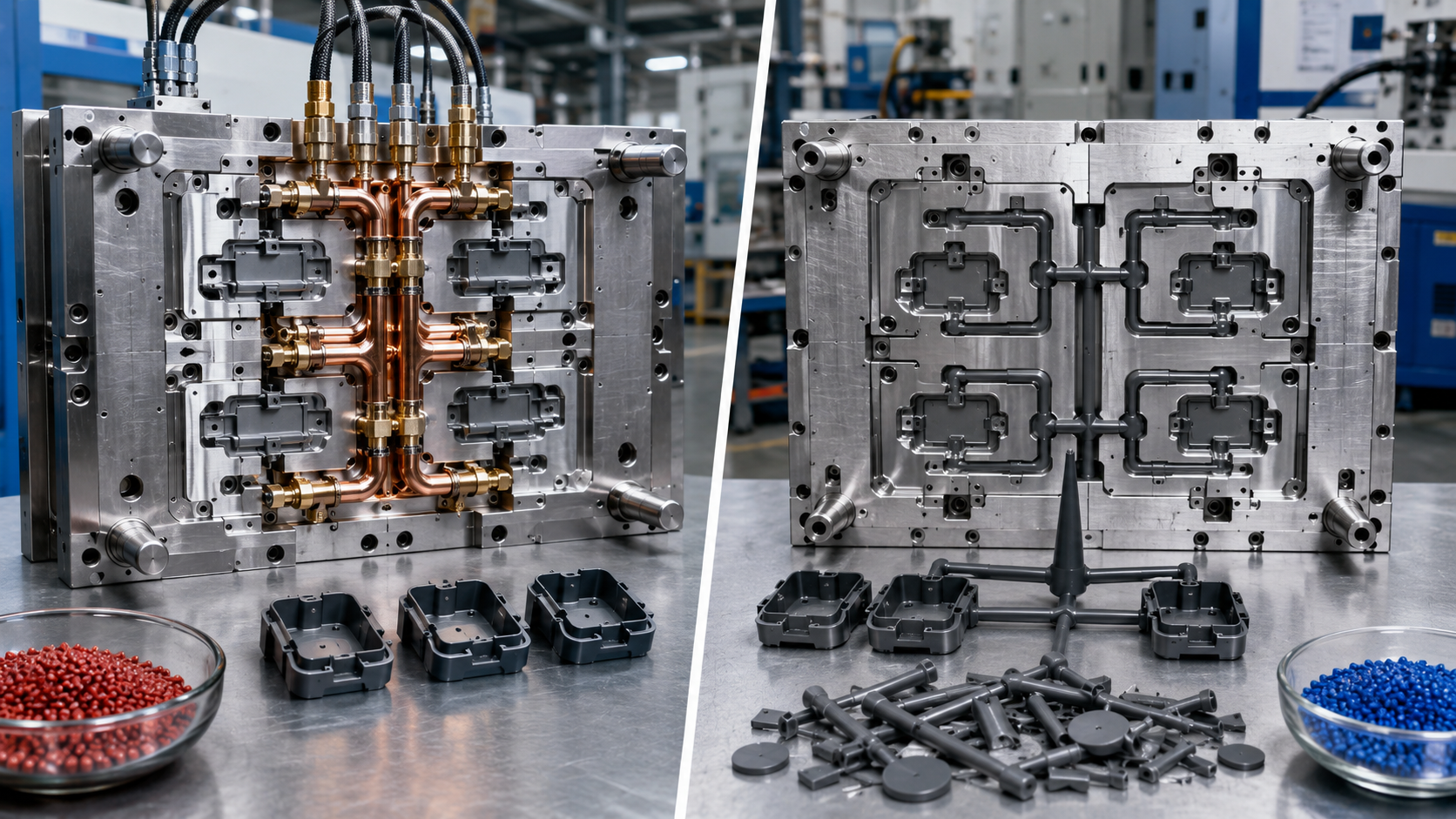
Choosing between a hot runner and a cold runner is one of those tooling decisions that looks simple from far away and gets spicy the closer you get. Both systems can produce strong, consistent molded parts, but they affect cost, scrap, cycle time, maintenance, resin behavior, and long-term production economics in different ways.
For product teams and buyers, the question is not “Which one is better?” The better question is: which runner system fits the part design, material, production volume, and cost target? A hot runner may reduce scrap and support high-volume production, but it can also increase tooling cost and maintenance complexity. A cold runner may be simpler and more flexible, but it can create more material waste depending on the part and runner layout.
This guide compares hot runner vs cold runner tooling so engineering, sourcing, and manufacturing teams can make a cleaner decision before committing to injection mold tooling.
What Is a Cold Runner System?
A cold runner system uses unheated channels to carry molten plastic from the machine nozzle to the mold cavity. During each molding cycle, the plastic in the runner cools along with the part. When the mold opens, both the molded part and the solidified runner are ejected.
That runner material may be discarded, reground, or reused depending on the resin, quality requirements, customer specifications, and part application. This is where cold runner economics can shift quickly. On a simple part with low material cost, cold runner scrap may not be a big problem. On a high-volume part using an expensive engineered resin, that same runner can become a very loud little cost goblin.
Cold runner tooling is often chosen because it is generally simpler than a hot runner system. It can be easier to maintain, easier to modify, and more practical for lower-volume programs or parts where design changes may still happen.
What Is a Hot Runner System?
A hot runner system uses heated components to keep plastic molten inside the runner channels. Instead of ejecting a solid runner with every cycle, the system delivers resin directly into the cavities while minimizing or eliminating runner scrap.
Hot runner tooling is often used when production volumes are high enough to justify the added upfront investment. By reducing runner waste and improving cycle efficiency in the right applications, hot runner systems can support better long-term unit economics.
The tradeoff is complexity. Hot runner systems include heaters, temperature controls, manifolds, nozzles, wiring, and sometimes more involved maintenance requirements. They can be excellent when properly matched to the resin and part design, but they are not a magic button labeled “save money.” Annoying, yes. True, also yes.
Scrap: The Most Obvious Difference
The biggest difference between hot runner and cold runner tooling is often material scrap. In a cold runner system, the runner solidifies and ejects with each shot. In a hot runner system, the runner material stays molten in the tool, so there is little to no runner scrap.
That matters most when resin cost is high, part volume is high, or the runner is large compared to the part. For small parts in a multi-cavity injection mold, runner weight can sometimes represent a meaningful share of the shot. In those cases, eliminating runner scrap may improve long-term economics enough to offset the higher tooling investment.
However, scrap calculations need to be honest. If regrind is allowed and quality is not affected, some cold runner waste may be reused. If the resin cannot tolerate regrind, or the customer requires virgin material, the scrap cost becomes more important. The right answer depends on resin behavior, application requirements, and production volume.
Cycle Time and Throughput
Runner strategy can also affect cycle time. Cold runners must cool enough to eject properly, and in some molds, runner cooling can influence the overall cycle. Hot runner systems can reduce that constraint because the runner remains molten and does not need to cool and eject as a solid piece.
In the right application, hot runner tooling may support faster cycles and higher throughput. This can be especially valuable for high-volume programs where a few seconds per cycle becomes a meaningful cost factor over thousands or millions of parts.
That said, cycle time is never only about the runner. Wall thickness, resin type, cooling design, part geometry, press selection, and quality requirements all matter. A hot runner will not fix a part that is poorly designed for molding. That is where early injection mold design review matters.
Tooling Cost: Upfront Investment vs Long-Term Economics
Cold runner tooling usually has a lower upfront cost because the system is simpler. For early-stage programs, lower-volume production, or parts with uncertain demand, that lower entry cost can be the right business move.
Hot runner tooling usually costs more upfront because of the additional system components and controls. The financial logic is that the higher tooling investment may be recovered over time through reduced scrap, better cycle efficiency, and improved production throughput.
This is why tooling strategy should be tied to the full production plan, not just the first quote. A lower tool price may look attractive, but if the program runs high volumes for years with expensive runner scrap, the total injection molding cost may not stay low.
Maintenance and Reliability Considerations
Cold runner systems are generally simpler to maintain because they have fewer heated components and fewer control points. This can make them attractive for straightforward parts, bridge programs, or applications where ease of maintenance is a major priority.
Hot runner systems require more attention. Heaters, thermocouples, tips, manifolds, and controls must be maintained properly. If the system is not well managed, issues like temperature imbalance, material degradation, gate vestige problems, or downtime can show up.
That does not mean hot runners are unreliable. It means they require the right maintenance discipline and the right technical fit. For a stable, high-volume program, that added complexity can be worth it. For a short run with frequent design changes, it may be overkill wearing a tiny expensive crown.
Resin Suitability: Not Every Material Loves Every Runner
Material behavior is a major factor in hot runner vs cold runner decisions. Some resins process well in hot runner systems. Others may be more sensitive to heat history, residence time, shear, or degradation. Color changes, filled materials, flame-retardant grades, and temperature-sensitive resins can also influence runner strategy.
Cold runner tooling may be more forgiving for certain materials or for programs where color changes are frequent. Hot runner tooling can be highly efficient, but the material must be compatible with the system design and temperature control strategy.
Before choosing a runner system, teams should confirm:
- Resin type and processing temperature range
- Heat sensitivity and residence time concerns
- Whether regrind is allowed
- Color change frequency
- Use of fillers, additives, or flame retardants
- Cosmetic requirements near the gate
These details help prevent a tooling choice that looks efficient on paper but becomes difficult in production.
Part Design and Gate Location
Runner strategy also affects gate location, appearance, fill behavior, and part performance. A hot runner system may allow more direct gating options and can support multi-cavity layouts efficiently. A cold runner system may provide flexibility in runner balancing and can be practical for simpler tools or lower-volume parts.
Gate location matters because it affects how the part fills, where weld lines form, how packing pressure is applied, and whether gate marks are acceptable. If the part has a cosmetic surface, sealing feature, or tight tolerance area, the runner and gate strategy should be reviewed early.
A strong DFM review should consider whether the chosen runner system supports:
- Balanced filling across cavities
- Acceptable gate appearance
- Stable packing and shrink control
- Reduced risk of warpage or sink
- Consistent part dimensions at critical features
This is where tooling decisions connect directly to part quality.
Multi-Cavity Tools and Runner Strategy
Runner choice becomes especially important in a multi-cavity tool. As cavity count increases, the system has to deliver material consistently so each cavity produces parts with the same dimensions, appearance, and performance.
Hot runner systems are often attractive in multi-cavity applications because they can reduce runner waste and improve material delivery efficiency. But the system must be designed and controlled carefully to maintain balance across cavities.
Cold runner systems can also support multi-cavity tools, but runner layout, balance, runner weight, and scrap strategy become more important. If one cavity fills differently from another, quality issues may appear as random fit or cosmetic variation.
For high-volume programs, it is worth comparing the total cost of each approach across the expected life of the tool. The better option is the one that supports stable production with the best combination of quality, cost, and maintainability.
When a Cold Runner May Be the Better Fit
A cold runner may be the better option when the program prioritizes lower upfront tooling cost, design flexibility, simpler maintenance, or lower production volume. It can also make sense when the resin is sensitive to extended heat exposure, regrind is acceptable, or the runner scrap is small enough that it does not significantly affect cost.
Cold runner tooling often works well for parts where production needs are moderate, the application is straightforward, or the program may still change after early production. In these cases, the simplicity of the system can be a real advantage.
When a Hot Runner May Be the Better Fit
A hot runner may be the better option when production volume is high, resin cost is significant, runner scrap would be expensive, or cycle efficiency is critical. It can also be useful in multi-cavity tools where the goal is to maximize throughput and reduce material waste over time.
Hot runner tooling is often strongest when the design is stable, the material is compatible, and the production plan justifies the added tooling investment. In other words, it makes the most sense when the program is ready for a more optimized production strategy.
Questions to Ask Before Choosing Hot Runner vs Cold Runner
Before selecting a runner system, engineering and sourcing teams should ask practical questions that connect tooling strategy to production reality:
- What is the expected annual volume and program life?
- How expensive is the resin, and is regrind allowed?
- How large is the runner compared to the finished part?
- Does the resin tolerate hot runner processing well?
- How often will color or material changes occur?
- Does the part have cosmetic, sealing, or tight tolerance gate concerns?
- Is the design stable enough to justify a more complex tool?
- How will maintenance be handled over the life of the program?
These questions help keep the decision grounded in cost, quality, and manufacturability instead of tooling mythology.
The Right Runner Choice Depends on the Whole Program
The hot runner vs cold runner decision should not be made in isolation. It affects scrap, cycle time, maintenance, resin suitability, gate strategy, part quality, and long-term economics. A cold runner can be the smarter choice for flexibility and simplicity. A hot runner can be the smarter choice for high-volume efficiency and material savings. The trick is matching the tool to the program instead of forcing the program to behave.
If your team is evaluating runner strategy for a new molded part, Hansen Plastics can help review part design, resin requirements, production volume, and tooling tradeoffs. Explore Hansen’s injection mold tooling capabilities or learn more about plastic injection molding support for production programs.