



Delays in delivery can slow down manufacturing operations and affect long-term supply relationships, customer trust and repeat orders. In molding industries, production timing depends on machines, material flow, and planning. When these are not connected, delays become frequent, and harder to control.
Studies show that real-time data synchronization can reduce production delays by 15–25%, as it removes gaps caused by manual tracking. This is where ERP integration becomes useful in creating a structured production system.
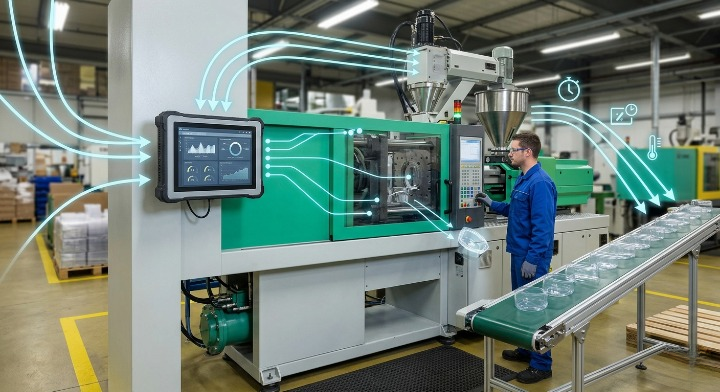
Integration of ERP connects machines and planning into one system. An Industrial Injection Molding Machine, and a Plastic Molding Machine become easier to track across the factory when linked to a digital platform.
An Integrated ERP System supports better control over production, inventory, and dispatch planning. Businesses using ERP-integrated systems report 20–30% improvement in on-time delivery rates and 18–22% better production planning efficiency helping create more stable, and predictable delivery schedules.
What is ERP Integration in Manufacturing?
ERP integration in manufacturing connects machines, production data, inventory and planning into one real-time system.
It connects shop-floor operations directly with business planning so decisions rely on live production data instead of delayed reports.
An Integrated ERP System gives managers the ability to track production status without waiting for manual updates. When a Plastic Molding Machine sends live output data planning becomes more accurate. The same applies to an Industrial Injection Molding Machine where cycle time and output affect delivery schedules.
Key Functions include
- Live production tracking
- Machine-level data capture
- Order, and inventory syncing
- Production planning updates
- Delay alerts, and reporting
What Are the Challenges in Traditional Molding Production?
Many factories still rely on manual tracking systems. This creates gaps between planning, and execution.
Some common problems are:-
- Manual entry errors in production logs
- Delayed updates from shop floor
- Poor coordination between teams
- Untracked machine downtime
- Material shortages during production
- Missed dispatch schedules
When preparing a Plastic Molding Machine even minor delays in reporting can cause the batch’s overall plan to change. In an Industrial Injection Molding Machine setup, unexpected stops can mess up whole order processes. Without ERP integration, teams usually react to problems after they occur instead of stopping them early.
How ERP Integration Deal With These Challenges?
Connected systems are becoming more common in modern factories. Integration of ERP takes guessing out of managing production. This is how it makes control better:-
Real-Time Machine Tracking
Every Plastic Injection Molding Machine sends live data to the system. Output, and cycle time are tracked automatically and downtime is recorded instantly.
Smarter Production Control
Work orders update automatically based on machine performance. Job priorities change in real time so scheduling stays more stable.
Better Machine Coordination
An Industrial Injection Molding Machine is tracked for running time maintenance needs, and output efficiency. This keeps performance under control.
Early Delay Detection
An Integrated ERP System sends alerts for machine stoppage low material stock and delayed production batches.
Reduced Manual Work
Less dependency on spreadsheets reduces communication gaps between teams. It also speeds up decision-making in daily production.
With ERP integration, production teams act early and stop delays from turning into bigger issues.
Key Benefits for On-Time Delivery
On-time delivery is a key performance factor in business manufacturing relationships and large-scale supply agreements. A delay can affect entire supply chains. Companies get these benefits from having a connected system:
Better Planning Accuracy
Demand forecasting becomes more reliable. Production schedules rely on real-time data making planning closer to shop-floor conditions.
Faster Order Execution
Machine idle time reduces, and production shifts quickly between batches. Operations continue without delays.
Stronger Department Coordination
Production inventory, and logistics teams use the same updated system data. This improves coordination, and reduces mismatches between departments.
Improved Inventory Control
Raw materials are tracked in real time, and stock remains available during production. This supports a steady manufacturing flow.
Higher Delivery Reliability
Fewer last-minute changes are needed and dispatch planning becomes more stable and predictable.
A Plastic Molding Machine running on a connected system faces fewer interruptions during production. An Industrial Injection Molding Machine also benefits from improved scheduling, and lower downtime. Integration of ERP makes the order-to-delivery process run more smoothly and reliably.
What to Consider Before Implementation?
Planning is needed to set up ERP Integration, not just installing software. Some important factors are:
System Compatibility
ERP systems should connect easily with existing production machines and software. When systems match well production data flows in real time without breaks. This makes monitoring more reliable.
Employee Training
Teams working on the shop floor, and in planning roles should be familiar with dashboards and live data. This leads to system insights being used in daily operations without confusion, resulting in better overall efficiency.
Data Accuracy
Giving accurate information at every stage helps with clear reporting, and making better choices about planning. Consistency is maintained through regular checks, which also make sure that production records match up with real performance.
Machine Connectivity
A Plastic Molding Machine should be configured to share consistent signals with the system. Similarly, an Industrial Injection Molding Machine must send stable data so that tracking, and analysis remain accurate across shifts.
Maintenance Planning
Prior planning is needed for system changes and sensor checks. Ongoing use of this method assures steady data flow and steady ERP system performance.
A strong Integrated ERP System performs best when both technology setup, and shop-floor practices work together in coordination.
Real Production Impact: Where ERP Creates Value?
Companies using ERP integration in molding operations see clear improvements in day-to-day production performance.
Production cycles become faster as planning matches real-time machine data. Machine downtime also reduces because issues are found early, and handled without delay. Inventory management becomes more structured, and keeps material flow steady during production. Scrap levels reduce as processes become more controlled and on-time delivery improves.
In real use cases, a plant using a Plastic Molding Machine reduced dispatch delays by improving real-time scheduling. A setup with an Industrial Injection Molding Machine improved output tracking through an Integrated ERP System. Another factory strengthened shift coordination by using ERP dashboards for live production visibility.
With better access to live data, teams make decisions faster, and with more accuracy, leading to smoother production flow across operations.
Why ERP Integration Supports Long-Term Efficiency?
For manufacturing to work smoothly over time, repeat orders and reliable delivery are important. A fully integrated ERP system maintains a stable production environment by keeping operations aligned with real-time data.
It helps keep the output flow steady by minimizing delays between planning, and execution. Resource planning also becomes more effective because material usage, machine capacity, and production needs are tracked in a structured way.
With better visibility into operations, delivery cycles become more predictable. This improves coordination between teams, and strengthens customer confidence over time.
In a connected setup, a plastic molding machine reduces output planning uncertainty. Additionally, an Industrial Injection Molding Machine is easy to handle when working different shifts. With ERP integration, manufacturers move from reacting to problems to a more planned and controlled way of working.
Create More Predictable Production System
Manufacturers using molding machines can reduce delivery delays by connecting their operations with digital systems.
If a factory uses Plastic Molding Machine, connecting it with an Integrated ERP System improves visibility, and makes production planning easier to manage. In manufacturing similar to Hansen Plastics, one of the leading plastic companies in Illinois, ERP adoption reports show 10–20% reduction in order processing time due to streamlined workflows, and reduced manual coordination.
Better inventory visibility also matters. Industry ERP benchmarks show that real-time tracking systems can reduce stock-related delays by up to 25% and keep materials available during production cycles.
Start by identifying gaps in current process:
- Are there any delays with machine updates?
- How do you keep track of production?
- Are you likely to miss your delivery times?
If these issues exist, ERP integration can help align manufacturing, and delivery goals. With better control, and real-time data, companies like Hansen Plastics in the molding industry can reduce delays, improve coordination and maintain more consistent delivery performance in manufacturing operations.
Frequently Asked Questions
ERP integration in injection molding is a system that connects molding machines with production, inventory, and planning software. It helps track machine output, cycle time, and production status in real time.
It improves on-time delivery by providing real-time production updates, reducing machine downtime, and improving coordination between production, inventory, and dispatch teams.
ERP systems receive live data such as machine output, cycle time, production counts, downtime, material usage, and maintenance alerts from molding machines.
Yes, ERP integration tracks raw materials and stock levels in real time. This helps avoid shortages, improves material planning, and supports continuous production flow.
Yes, small manufacturers can also benefit. ERP helps improve planning accuracy, reduce manual work, and provide better control over production even in smaller setups.
Implementation time depends on factory size and system complexity. In most cases, it can take a few weeks to a few months, including setup, testing, and training.
Industries such as automotive, packaging, consumer goods, electronics, and medical device manufacturing benefit from ERP-integrated molding systems due to better production control and delivery accuracy.