



If you’re sourcing plastic parts, it’s easy to lump everything into one mental bucket called “molding.” But the manufacturing method you choose can quietly decide your cost structure, lead time, quality consistency, and even whether your part performs the way it should in the field.
Two processes that often get compared are injection blow molding and injection molding. They can both produce high-quality plastic parts at scale, but they are built for different part geometries and performance requirements. This guide breaks down what each process is best at, how to choose between them, and what to look for during quoting.
The simplest difference: what each process is designed to make
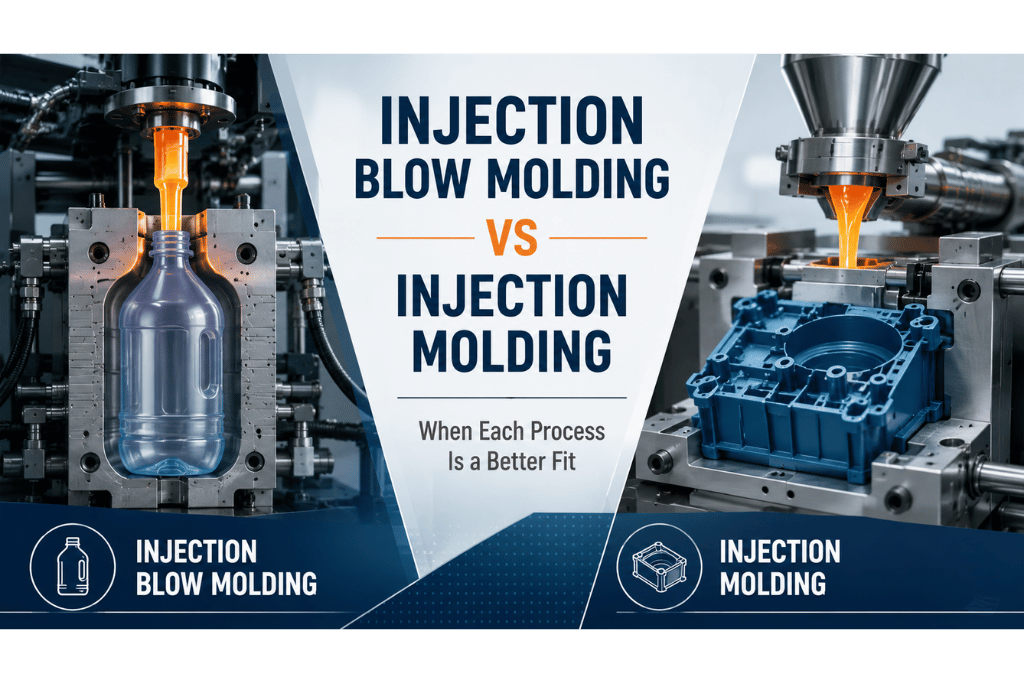
Injection molding is optimized for solid parts with detailed geometry, ribs, bosses, snap fits, and precise features. Plastic is injected into a closed mold cavity, cools, and ejects as a finished part.
Injection blow molding is optimized for hollow parts, especially containers and fluid-holding components where internal geometry and wall uniformity matter. The part is formed by creating a preform and then blowing it into a hollow shape inside a mold.
A quick rule of thumb that’s usually true:
- If your part is a solid component with structural features, injection molding is likely the fit.
- If your part is a hollow container that needs consistent walls, injection blow molding is likely the fit.
But there are important exceptions, and that’s where the “when” gets interesting.
Part geometry: the biggest decision driver
When injection molding wins on geometry
Injection molding is usually the better fit when your part needs:
- Complex features (ribs, bosses, snaps, living hinges, threads)
- Tight tolerances on critical dimensions
- Controlled flatness, sealing surfaces, or mating interfaces
- Inserts, overmolding, or multi-material options
- High structural strength in a compact footprint
It’s the go-to process for housings, brackets, enclosures, covers, structural supports, and functional components where geometry is doing real work.
When injection blow molding wins on geometry
Injection blow molding is usually the better fit when your part is:
- Hollow and needs a consistent internal volume
- A bottle, reservoir, fluid container, or similar vessel
- Designed around uniform wall thickness for performance and durability
- Sensitive to weight optimization (thin but strong walls)
It excels when “hollow, consistent, and repeatable” is the job description.
Volume and economics: why the same part can be “cheap” or “expensive”
Both processes can be cost-effective at scale, but the economics behave differently depending on geometry and production intent.
Injection molding costs are heavily influenced by:
- Tooling complexity (slides, lifters, hot runner, multi-cavity)
- Cycle time and press size
- Material cost and scrap strategy
- Secondary operations and assembly requirements
Injection blow molding costs are heavily influenced by:
- Container design and wall thickness strategy
- Material distribution consistency
- Cycle speed for the target part size
- Neck finish requirements and dimensional control
The key point: economics don’t come from the process name. They come from whether your part’s geometry matches what the process is naturally good at.
Performance requirements: what matters after the part leaves the factory
If you’re deciding between processes, ask what matters most in real use.
Structural and mechanical performance
Injection molded parts are typically chosen when you need predictable structural behavior, stiffness, and repeatable interfaces for assemblies. If the part will be loaded, fastened, snapped, or bolted into a larger system, injection molding tends to offer better control.
Leak resistance and wall uniformity
Injection blow molding is often chosen when internal volume, wall uniformity, and container performance are the priorities. The ability to create consistent hollow forms can reduce weak spots that lead to cracking or leaks over time.
Tolerances and precision features
Injection molding is generally the better option when tight tolerances are needed on functional features, especially if the part must mate with other components in a consistent way.
That doesn’t mean blow molded parts can’t be consistent. It means injection molding is typically the process you reach for when precision features are the center of gravity.
Lead time: what really affects your schedule
Lead time is not just “how fast can you make parts.” It’s how fast you can get from design to stable production.
Injection molding lead time is shaped by:
- DFM alignment and design approvals
- Tool build complexity
- Sampling, tuning, and validation cycles
Injection blow molding lead time is shaped by:
- Container geometry maturity and design validation
- Tooling and preform strategy alignment
- Consistency targets for wall distribution and neck features
If your design is still changing frequently, both processes will punish you. The fastest programs are the ones where the team locks key decisions early, especially on geometry and performance targets.
The questions to ask during quoting
If you’re comparing suppliers or deciding between processes, these RFQ questions will save you time and prevent expensive assumptions.
Geometry and functionality
- Is the part primarily structural or primarily a container?
- What critical features must hold tight tolerance?
- Are sealing surfaces or mating interfaces critical-to-function?
Volumes and ramp
- What are the realistic annual volumes and ramp plan?
- Do we need bridge production or validation builds first?
Performance environment
- Will the part see chemicals, UV exposure, temperature swings, or impact?
- Are leak risk and long-term durability primary concerns?
Cost and scope clarity
- What assumptions are included (material, cavity count, cycle time, scrap, inspection)?
- What changes would trigger a re-quote or tool rework?
If a supplier answers these clearly, you’re dealing with a grown-up operation.
A quick decision guide
If you want a simple starting point:
Injection molding is often the better fit when:
- The part is solid and feature-rich
- Tolerances and assembly fit matter
- You need ribs, bosses, snaps, or inserts
- Structural performance is a priority
Injection blow molding is often the better fit when:
- The part is hollow and container-like
- Wall uniformity is critical
- Weight optimization matters
- Leak resistance and container durability drive the design
And if your part sits in the gray zone, the best move is to share your CAD and performance requirements early and ask for a DFM-style recommendation. A good manufacturer won’t just quote, they’ll explain which process de-risks your program.
Choosing the right process is a program decision
The “best” process is the one that matches your geometry, volume, and performance needs with the least drama. When injection blow molding is used for container-type parts, it can deliver excellent durability and consistency. When injection molding is used for structural, feature-rich parts, it can provide repeatable precision and scalable economics.
If you’re evaluating options, an experienced molding partner should be able to review your part requirements and quickly tell you which process fits naturally, what tradeoffs exist, and how to avoid the common traps that drive cost and lead time up.