



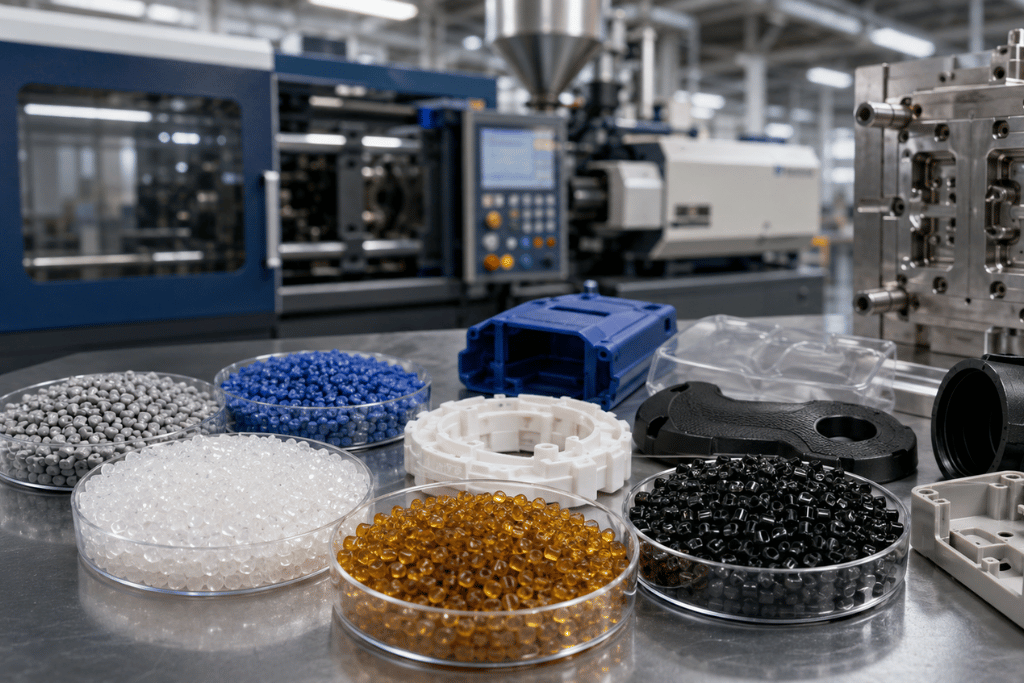
Choosing the right resin is one of the most important decisions in any molded part program. Geometry, tooling, process control, and quality systems all matter, but the material is what determines how the part behaves in the real world. A design can look perfect in CAD and still fail if the resin cannot handle the application’s heat, chemicals, impact, UV exposure, or cosmetic expectations.
This guide explains how product teams, engineers, and sourcing teams can compare common plastic injection molding materials based on performance, cost, appearance, and manufacturability. The goal is not to crown one “best” resin. That would be too easy, and frankly, suspicious. The right material is the one that fits the part’s job, environment, volume, and budget.
Start With the Application, Not the Resin Name
Many material selection problems start when teams jump straight to a familiar resin. Someone says “Let’s use ABS” or “Can this be polypropylene?” before the part requirements are fully defined. Sometimes that works. Other times, it creates a part that cracks, warps, discolors, absorbs chemicals, or becomes more expensive to mold than expected.
A better starting point is the application. Before choosing a resin, define what the part needs to survive. Will it live outdoors? Will it contact chemicals? Does it need to flex, snap, seal, carry load, or look polished on a customer-facing surface? These questions matter because resin selection affects not only performance, but also plastic injection molding cost, cycle time, tooling decisions, and quality control.
Key Factors to Compare When Selecting Plastic Injection Molding Materials
Most molded parts fail because one or two real-world requirements were underestimated. A material may be inexpensive, easy to mold, and widely available, but if it cannot handle the operating environment, the savings disappear quickly. When comparing materials, focus on the conditions the part will actually see.
Chemical Resistance
Chemical resistance is critical for parts exposed to cleaners, oils, fuels, fertilizers, lubricants, disinfectants, or industrial fluids. Some plastics tolerate certain chemicals well, while others can swell, soften, crack, or lose strength. The tricky part is that chemical resistance is not always obvious at first. A component can pass an initial fit check and still fail later through environmental stress cracking, especially when chemical exposure combines with mechanical load.
If chemical contact is expected, provide the specific chemicals, exposure frequency, and contact type during the RFQ process. Splash exposure is very different from full immersion, and room-temperature exposure is very different from chemical contact near heat.
Temperature Performance
Temperature affects stiffness, impact resistance, creep, and dimensional stability. A resin that performs well at room temperature may soften near a heat source or become brittle in cold conditions. This matters in automotive, agriculture, appliance, industrial, and fluid movement applications where parts can experience heat cycles or outdoor storage conditions.
Temperature requirements should include both operating and storage ranges. If a part sits in an unheated facility, near a motor, under outdoor sunlight, or inside a warm enclosure, that should be documented before material selection begins.
Impact Strength and Toughness
Impact strength matters when parts are dropped, assembled under force, exposed to vibration, or used in rugged environments. Toughness is especially important around bosses, ribs, snap fits, threaded areas, and other geometry where stress can concentrate. A material with high stiffness may still crack if the design creates sharp stress points or if the material becomes brittle at lower temperatures.
This is where material selection and injection mold design have to work together. Resin choice can improve durability, but geometry still decides where stresses collect.
Cost and Availability
Material cost is usually one of the first things procurement notices, but resin price is only one part of the true cost. Some materials cost more per pound but mold faster, reduce scrap, or avoid secondary operations. Others look affordable at the resin level but require longer cycle times, tighter process control, or more expensive tooling decisions.
That is why material selection should be reviewed as part of total program cost, not as a standalone line item. The right resin can reduce field failures, improve consistency, and help control long-term production costs.
Appearance and Cosmetic Requirements
Not every molded part needs to look beautiful. Some parts live inside assemblies and only need to perform. Others are customer-facing and need consistent color, gloss, texture, and surface finish. Materials vary widely in how they accept color, show flow lines, resist scratching, and maintain appearance over time.
If appearance matters, define the cosmetic surface early. Gate location, texture, resin behavior, and processing conditions all influence final appearance. Waiting until first shots to discuss cosmetics is how programs wander into the swamp wearing dress shoes.
Common Plastic Injection Molding Materials and Where They Fit
The table below gives a practical overview of common resin families used in injection molding. These are general guidelines, not final material recommendations. Exact grades, additives, fillers, and processing requirements can significantly change performance.
| Material | Common Strengths | Common Considerations | Typical Application Fit |
|---|---|---|---|
| Polypropylene (PP) | Lightweight, flexible, chemical resistant, cost-effective | Can have lower stiffness and may need stabilization for outdoor use | Covers, housings, containers, living hinges, chemical-contact parts |
| Polyethylene (PE) | Excellent chemical resistance, toughness, moisture resistance | Can be more difficult to hold tight tolerances depending on grade and geometry | Fluid components, tanks, caps, outdoor and utility parts |
| ABS | Good impact strength, rigidity, and cosmetic appearance | Not always ideal for harsh chemical or UV exposure without modification | Enclosures, appliance parts, housings, consumer-facing components |
| Nylon (PA) | High strength, wear resistance, heat performance | Moisture absorption can affect dimensions and performance | Gears, brackets, structural parts, wear components |
| Polycarbonate (PC) | High impact strength, toughness, transparency in some grades | Can be more expensive and may require careful processing | Protective components, lenses, safety-related parts, durable housings |
| Acetal (POM) | Low friction, dimensional stability, wear resistance | Chemical compatibility and processing controls must be reviewed carefully | Precision components, bushings, clips, moving parts |
| TPE / TPU | Flexible, rubber-like feel, grip, sealing, cushioning | Requires careful design for bonding, flow, and long-term performance | Seals, grips, soft-touch features, multi-material components |
How Materials Affect Injection Molding Cost
Material choice directly influences injection molding cost. Resin price is the obvious factor, but it is rarely the only one. Materials that require drying, higher processing temperatures, longer cooling times, or tighter controls can increase total production cost. Filled materials can improve stiffness and strength, but they may also increase tool wear or influence surface finish.
A realistic cost review should consider resin price, cycle time, scrap risk, part weight, secondary operations, and quality requirements. If a lower-cost resin increases defects or requires extra inspection, the “savings” can vanish faster than a sample part at an engineering review.
How Materials Influence Injection Mold Design
Resin behavior affects shrink, flow, cooling, warpage, and final part dimensions. That means material selection should happen before tooling decisions are locked. If the material changes after tool design, the mold may no longer be optimized for the part’s actual behavior.
For example, some materials need more generous radii to reduce stress concentration. Others require specific gating strategies to control cosmetic surfaces or avoid weak weld lines. Filled materials may shrink differently along flow direction, which can influence warpage and tolerance planning.
This is why early DFM review is so valuable. A team that understands both resin behavior and injection mold tooling can help align material, geometry, and process before expensive changes are cut into steel.
Material Selection and Common Injection Molding Defects
Some injection molding defects are process-related, but many are tied to the interaction between material and design. Warpage, sink, flash, brittleness, surface defects, and dimensional variation can all become more likely when the resin is poorly matched to the part.
For example, a material with high shrink variation can make tight tolerances harder to hold. A resin that cools slowly can increase cycle time and make thick sections more prone to sink. A brittle material used around sharp corners or snap features may crack during assembly. The resin does not work alone. It behaves inside the geometry, tool, and process window you give it.
What to Document Before Choosing a Resin
To make material recommendations more accurate, document the part’s real use case before quoting. This does not need to be a giant novel with a leather cover. A clear, practical requirement list is enough.
- Part function and failure risk
- Operating and storage temperature range
- Chemical exposure, including contact type and frequency
- UV or outdoor exposure expectations
- Impact, vibration, or load requirements
- Cosmetic expectations for visible surfaces
- Critical-to-fit and critical-to-function dimensions
- Annual volume and expected production life
If the part is still in development, consider whether low volume injection molding can support validation before committing to full production tooling. Production-intent samples can reveal whether the selected material performs as expected in assembly and in the field.
Choosing the Best Material Is a Tradeoff, Not a Guess
The best plastic injection molding material is not always the strongest, cheapest, clearest, toughest, or easiest to mold. It is the material that balances the requirements of the application with the realities of manufacturing. A resin that performs beautifully in one program may be the wrong choice for another if the environment, geometry, or cost targets change.
For product teams, the smartest path is to compare materials through the lens of chemical resistance, temperature, impact, cost, appearance, and manufacturability. From there, an experienced molding partner can help narrow the options, identify tradeoffs, and align the selected resin with the mold design and production process.
If you are evaluating materials for a new molded part, Hansen Plastics can help review resin options, manufacturability concerns, and production requirements so your program starts with a material strategy that supports performance, consistency, and long-term value.