


When people talk about injection molding, they usually focus on the part design, the resin, or the mold. All of those matter, of course, but the plastic injection molding press itself plays a major role in part quality, consistency, and cost. Even a well-designed mold can produce unstable results if it is running in the wrong press.
That is why press selection is more than a shop-floor detail. It is an engineering decision that affects repeatability, defect rates, cycle time, and how reliably your part holds tolerance over time. If the machine does not match the part and tooling requirements, you can end up fighting flash, short shots, warpage, dimensional drift, and other problems that look like “molding issues” but are really machine-fit issues.
This guide covers the basics of plastic injection molding presses and explains how matching the right press to the part helps reduce defects and improve performance.
What a plastic injection molding press actually does
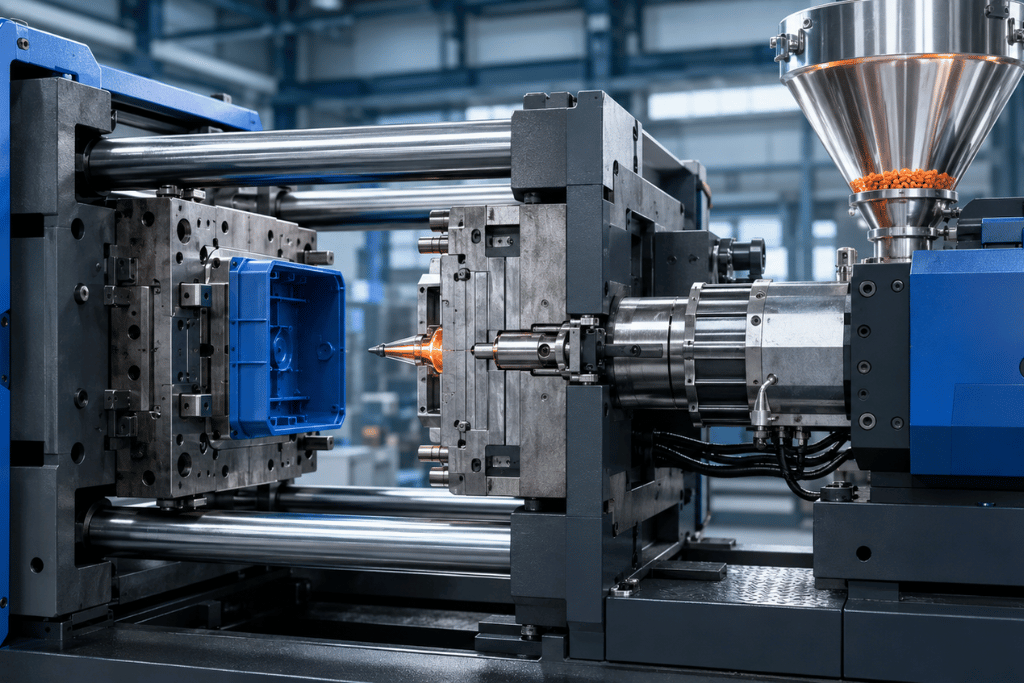
At the most basic level, an injection molding press melts plastic, injects it into a mold, holds the mold closed under pressure, allows the part to cool, and then ejects the finished component. That sounds straightforward, but several machine variables affect how well that cycle happens.
A press is not just “big enough” or “not big enough.” It has to be appropriate for the tool, the part geometry, the material, and the process window. A mismatch in any of those areas can create instability that shows up as cosmetic defects, dimensional inconsistency, or unnecessary wear on the tool.
Why press selection matters more than many buyers realize
A lot of sourcing conversations focus on tooling and resin, while the machine itself gets treated like a given. In reality, the press has a direct influence on how consistently a molder can reproduce the same part shot after shot.
When the machine is well matched to the job, the process tends to be more stable. The part fills more predictably, the mold stays properly clamped, and the team has more control over critical dimensions. When the machine is a poor fit, even a capable molder ends up working inside narrower limits and compensating for problems that could have been prevented upfront.
That is why press selection ties directly into injection molding tolerances, defect reduction, and long-term repeatability.
Tonnage: the first machine spec people ask about
Tonnage refers to the clamp force the press uses to keep the mold closed during injection. If the press does not provide enough clamp force, the mold can separate slightly under pressure, which often leads to flash and dimensional inconsistency. If the press is dramatically oversized, it may still run the tool, but the program can become less efficient or more expensive than it needs to be.
Clamp force must be matched to the projected area of the part and the injection pressure required to fill it. Larger parts, thinner walls, and more demanding geometries may all affect how much tonnage is needed.
Proper tonnage selection helps prevent:
- flash at the parting line
- unstable part dimensions
- excessive tool wear from poor clamping balance
- process inconsistency across production runs
Tonnage is one of the clearest examples of why machine fit matters. Too little creates obvious risk, but too much is not automatically “better.”
Shot size: why the volume of material matters
Shot size is the amount of molten plastic the press can inject in one cycle. It needs to align with the total material required for the part, the runner system, and any process cushion needed for stable packing.
If the shot size is too small, the process may struggle to fill the mold consistently, which can contribute to short shots or unstable packing. If the shot size is too large relative to the part, the resin may sit too long in the barrel, potentially affecting material stability, especially for more sensitive resins.
A well-matched shot size helps support:
- more consistent fill behavior
- stable packing pressure
- improved part-to-part repeatability
- better control of cosmetic and dimensional outcomes
This is especially important for parts with tight fit requirements or critical sealing features.
Other press factors that affect part quality
Tonnage and shot size get most of the attention, but they are not the only machine characteristics that matter. A plastic injection molding press also needs to accommodate the physical and processing requirements of the mold and resin.
Tie bar spacing and platen size
The mold has to physically fit the press. Tie bar spacing and platen dimensions determine whether the tool can mount correctly and operate safely. A machine may have enough tonnage on paper but still be a poor physical fit for the tool.
Injection pressure and injection speed capability
Some parts require higher pressure or faster fill rates to mold correctly, especially when they involve thin walls, long flow paths, or detailed features. If the machine cannot support the required injection profile, the process window becomes more limited.
Screw and barrel suitability
The screw design and barrel size should be appropriate for the resin and shot size. This matters for melt consistency, temperature control, and material handling.
Mold support and process stability
A machine that fits the tool properly tends to support better cycle-to-cycle stability. That stability is what helps reduce scrap and keep parts within tolerance.
What happens when the wrong press is used
When a press is not well matched to the mold and part, the symptoms often show up as recurring quality issues. Teams may spend time adjusting process settings without realizing the machine itself is part of the problem.
Common issues linked to poor press selection include:
- Flash, often caused by insufficient clamp force or unstable tool support
- Short shots, when the machine struggles to fill the part consistently
- Warping, especially when fill, pack, or cooling consistency is compromised
- Sink, if packing performance is unstable
- Dimensional variation, which makes holding tolerances harder
- Cycle inefficiency, when the machine is oversized or poorly matched to the job
These are the kinds of injection molding defects that can quietly increase cost through scrap, sorting, delays, and rework.
Press selection and injection molding tolerances
Tolerance control in injection molding is not only about tool precision. It also depends on whether the machine can reproduce the same process conditions over and over again. If clamp force, fill behavior, or material delivery drift from shot to shot, dimensions can drift too.
That is why programs with tighter tolerances often benefit from a very deliberate machine match. Stable press performance makes it easier to control the process window and keep critical-to-function dimensions within range. If your part has sealing surfaces, mating interfaces, snap features, or threaded areas, machine consistency becomes even more important.
In practical terms, a good press match helps the molder:
- maintain stable filling and packing
- reduce dimensional variation across runs
- better support critical-to-fit features
- protect consistency as tools age and volumes increase
How press selection connects to tooling
The press and the tool should never be evaluated separately. A mold is designed with assumptions about clamp force, shot capacity, machine layout, and process behavior. If those assumptions do not line up with the actual machine, the program can become harder to run than it should be.
This is where injection mold tooling strategy and press selection overlap. A supplier should be evaluating not only whether the tool can fit in a machine, but whether the machine can run the tool efficiently and repeatably over the life of the program.
For example, the right machine-tool match can influence:
- how reliably multi-cavity tools balance
- whether hot runner systems perform consistently
- how well the process holds on parts with tight tolerances
- how much tuning is needed during launch and scale-up
Questions to ask when reviewing a molding program
If you want better visibility into how a supplier is planning to run your part, it helps to ask a few targeted questions. You do not need to micromanage the press selection, but you do want to understand the assumptions behind the quote and the manufacturing plan.
Useful questions include:
- What press tonnage range do you expect to run this part on?
- How did you determine the clamp force requirement?
- What shot size are you assuming for the quoted configuration?
- Does the mold physically and operationally fit the target press well?
- Are there any machine-related constraints that could affect tolerances or cycle time?
- If demand scales, would the press strategy change?
These questions help expose whether the supplier is simply quoting a part or actually planning for stable production.
A good press match makes the whole process easier
The best molding programs are rarely dramatic. They are stable, repeatable, and uneventful in the best possible way. That kind of performance often comes from fundamentals being handled correctly early on, including selecting the right plastic injection molding press for the part and the tool.
When tonnage, shot size, and machine capability align with the molding requirements, the result is usually better quality, fewer defects, and more confidence in the program as volumes grow. For OEMs and procurement teams, that means fewer surprises and a smoother path from first shots to ongoing production.
If you are reviewing a new molding program, press selection is worth more attention than it usually gets. It may look like a technical detail, but it has a direct impact on part quality, cost, and repeatability.