



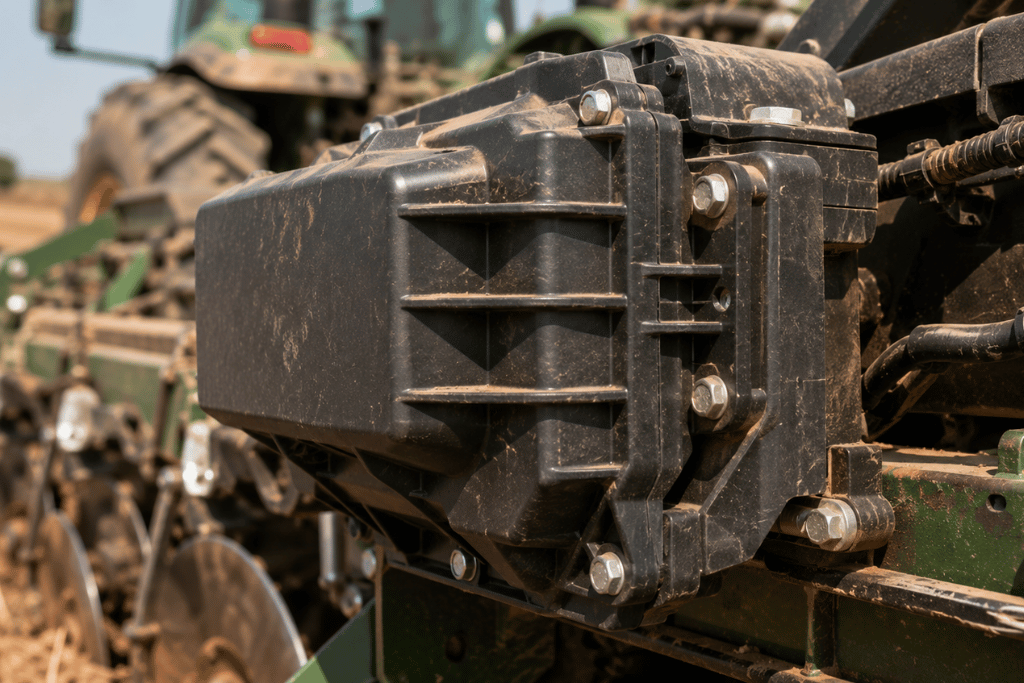
Agricultural equipment does not fail in a clean lab. It fails in the field, under vibration, in dust, near engines, around chemicals, and usually at the worst possible time. That’s why selecting and designing plastic parts for agricultural equipment needs a different mindset than general industrial plastic components. You’re not just choosing a material. You’re designing for uptime.
This guide covers the real-world factors that drive durability in continuous operation: heat exposure, vibration fatigue, abrasion and wear, chemical contact, and long-term fit stability. If your part needs to survive seasons of use, these are the things to define early, before tooling locks in the wrong assumptions.
Why continuous operation changes the durability game
Continuous operation amplifies small weaknesses. A minor stress riser becomes a crack starter. A slightly loose fit becomes a rattle and then a failure. A resin that “should be fine” becomes brittle after UV and heat cycling.
Agricultural plastics often see a stack of conditions at once:
- Heat near engines, pumps, or enclosed housings
- Vibration and cyclic loads for hours at a time
- Abrasion from grit, soil, and debris
- Chemical exposure from fuel, oil, hydraulic fluid, fertilizers, and cleaning agents
- Temperature swings that expand and contract assemblies daily
Your part’s design and material need to be chosen for the stack, not for one condition in isolation.
Heat: what it really does to plastic parts
Heat affects plastics in more ways than “melting point.” In agricultural equipment, heat exposure can cause:
- Softening that changes stiffness and fit
- Creep (slow deformation under load) that loosens joints and seals
- Accelerated aging and embrittlement over time
- Dimensional drift that shifts critical interfaces
What to specify about heat
If you want the right recommendation, give your supplier context like:
- Maximum operating temperature near the part
- Whether the part sees constant heat or short spikes
- Whether the part is enclosed (heat soak) or ventilated
- If the part is exposed to sunlight plus equipment heat
A part mounted near an engine bay is a different problem than a part sitting in ambient outdoor air.
Vibration: the fatigue problem nobody sees coming
Vibration failures usually don’t look dramatic at first. They start as micro-cracks that grow over time, often around:
- bosses and fastener points
- sharp internal corners
- thin-to-thick transitions
- clip/snap features and tight shutoffs
- plastic-to-metal interfaces
Design choices that improve vibration durability
A reliable vibration-resistant part typically has:
- Fillets at corners to reduce stress concentration
- Smooth transitions instead of abrupt geometry changes
- Reinforcement that adds stiffness without creating thick masses
- Proper support around fasteners and inserts
- Fit designed to avoid micro-movement (fretting) that wears interfaces
If the assembly moves slightly on every vibration cycle, it will eventually turn into wear, noise, and then failure.
Wear and abrasion: grit wins unless you plan for it
Agricultural environments are basically a grit factory. Wear shows up in parts that slide, rub, clamp, or repeatedly contact soil and debris. Over time, abrasion can:
- thin walls and weaken features
- loosen assemblies and change alignment
- damage sealing surfaces and lead to leaks
- increase vibration because fit becomes sloppy
What to define about wear
To prevent premature wear, clarify:
- Where abrasion occurs (contact surfaces, guides, clamps, housings)
- Whether contact is continuous sliding or intermittent rubbing
- If dirt, sand, or debris gets trapped in the interface
- Whether the part needs a sacrificial wear surface
Wear performance is part geometry plus material behavior. If you don’t specify the wear scenario, the design may be optimized for strength but not for survival.
Chemical exposure: the quiet cause of cracking
Agricultural equipment sees plenty of chemical contact:
- diesel, gasoline, oils, hydraulic fluid
- fertilizers and pesticides
- degreasers and cleaning agents
The tricky failure mode is environmental stress cracking, where chemicals and mechanical stress combine. The part can look fine, then suddenly crack at a threaded area, barb, or clamp interface.
If chemical exposure is possible, provide:
- a list of chemicals or product types
- whether exposure is splash, wipe, immersion, or vapor
- exposure frequency and temperature
This is one of the most important RFQ inputs for choosing materials that hold up over time.
Fit stability: uptime depends on assemblies staying tight
A part can be strong and still fail the program if fit drifts. In agriculture, fit drift creates:
- leaks in fluid systems
- rattles and wear in mounting interfaces
- cracked parts from over-tightening when crews “force it”
- inconsistent repairs because replacement parts don’t behave the same
Fit stability depends on:
- controlled shrink behavior and stable molding
- properly defined CTQs (critical-to-fit dimensions)
- tool maintenance practices over time
- process stability on the press (repeatability matters)
If the part is in an assembly, share mating part details. Fit is a system problem, not a single-part problem.
What to include in an RFQ for agricultural equipment plastic parts
If you want accurate quotes and fewer failures, include these upfront:
- Where the part lives on the equipment (near heat source? exposed? enclosed?)
- Operating and storage temperature range
- Vibration conditions (continuous, intermittent, high shock)
- Wear scenario (sliding contact, grit exposure, clamp interfaces)
- Chemical exposure list and frequency
- UV exposure level and target service life (if outdoors)
- Critical-to-fit and critical-to-function dimensions (CTQs)
- Assembly method (fasteners, inserts, snap fits, seals)
- Expected annual volumes and seasonality
- Any field service requirements (how often removed/reinstalled)
The better your inputs, the fewer assumptions a supplier has to make, and the more reliable your final part will be.
Designing for uptime is designing for reality
The best injection molded parts for agriculture are not the ones that look perfect on day one. They’re the ones that still work after heat cycles, vibration hours, grit exposure, chemical splashes, and real field handling.
If your goal is uptime, the best move is a short DFM and materials review focused specifically on heat, vibration, wear, and assembly stability. It’s cheaper to change a fillet, wall transition, or material strategy now than it is to chase cracks and leaks after production is already rolling.