



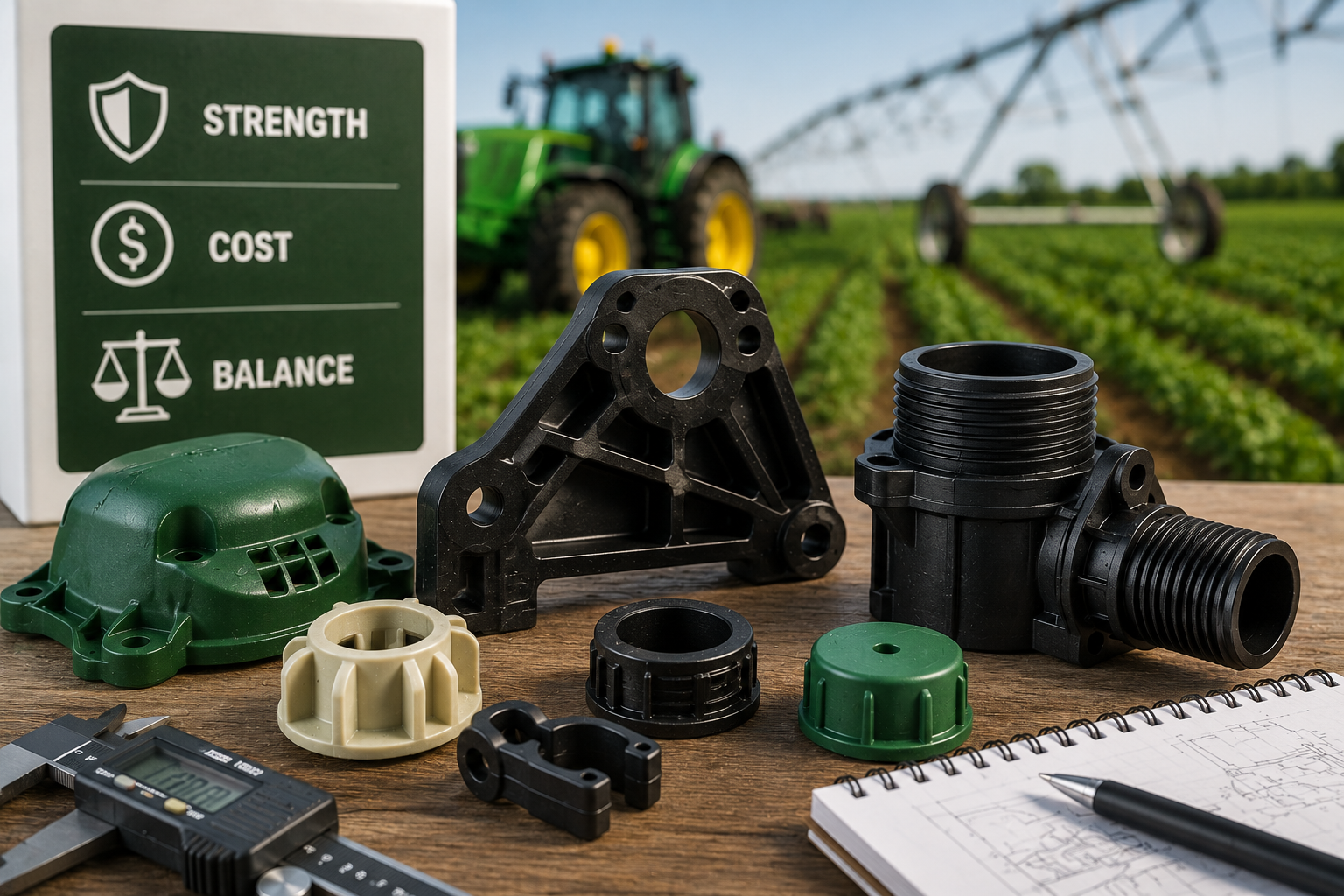
Agricultural components need to be tough, but “make it stronger” is not always the smartest instruction. Sometimes strength comes from better geometry. Sometimes it comes from material selection. Sometimes it comes from tighter process control. And sometimes, adding more material just makes the part more expensive, harder to mold, and more likely to warp. Plastic, as usual, likes to keep things dramatic.
For teams sourcing injection molded parts for agriculture, the goal is not to overbuild every component. The real goal is to balance performance and cost based on how the part is used. A protective cover, irrigation fitting, equipment bracket, greenhouse component, and structural housing all have different durability needs. Treating them the same can waste money or create avoidable failures.
This guide explains how to simplify geometry, adjust tolerances, and choose materials that keep cost controlled without sacrificing field performance in agricultural injection molding programs.
Start With the Real Failure Risk
The first step in balancing strength and cost is understanding what failure actually looks like. A part that fails cosmetically is not the same as a part that causes downtime, leaks, misalignment, safety concerns, or field repair costs. The more serious the failure consequence, the more intentional the design and material strategy need to be.
For agricultural parts, failure risk is often tied to where the component lives. A part mounted near heat, vibration, or moving equipment needs a different approach than a cover used mainly for protection. A fitting that seals fluid needs tighter control than a non-critical guard. A plastic-to-metal interface may need reinforcement, while a lightly loaded enclosure may not.
Before making the part thicker or choosing a more expensive resin, define the actual job of the component. That clarity keeps the design from becoming a cost monster wearing a “durability” name tag.
Strength Does Not Always Mean More Plastic
One of the most common cost traps in molded part design is using thickness as the default answer to strength. Thick walls can seem reassuring, but in injection molding they often create new problems. Heavier sections take longer to cool, increase cycle time, raise material cost, and can introduce sink, voids, internal stress, or warpage.
In many cases, strength is better achieved through geometry. Ribs, gussets, fillets, bosses, and well-supported load paths can improve stiffness and durability without turning the part into a chunky little resin brick. The design needs to guide force through the part cleanly instead of simply adding mass.
This is why early injection mold design review matters. A DFM review can identify where material is helping, where it is hurting, and where a geometry change could improve strength while reducing cost.
Use Ribs and Reinforcement Strategically
Ribs are useful because they can increase stiffness without dramatically increasing wall thickness. But ribs still need to be designed carefully. Oversized ribs can create sink marks, cosmetic read-through, warpage, and difficult cooling conditions. Poorly placed ribs can also concentrate stress instead of solving it.
For agricultural parts, rib design should support the way the part is actually loaded. If the component sees vibration, ribs may need to stabilize mounting points. If the part sees impact, ribs should avoid creating sharp stress risers. If the part supports assembly loads, reinforcement should be focused around fasteners, inserts, clips, or mating surfaces.
The best reinforcement is not just “more ribs.” It is the right structure in the right place, designed around molding behavior and field use.
Adjust Tolerances Based on Function
Tight tolerances are sometimes necessary. They protect sealing surfaces, snap fits, threaded features, alignment points, and critical assembly interfaces. But applying tight tolerances across the entire part can increase cost without improving performance.
For custom plastic manufacturing for agriculture, a better strategy is to separate critical dimensions from non-critical ones. A part may need tight control on an O-ring groove, barb diameter, fastener boss, or mating surface, while other dimensions can allow more variation without affecting function.
Right-sized tolerances help reduce:
- tooling complexity
- inspection burden
- scrap risk
- production slowdowns
- unnecessary cost in non-critical areas
This does not mean lowering quality. It means putting quality control where it actually protects the part.
Material Selection: Pay for the Properties You Actually Need
Material choice is one of the biggest levers in both performance and cost. It can be tempting to choose the strongest or most chemical-resistant material available, but that can quickly overbuild the part and inflate the budget. On the other hand, choosing resin based only on price can create field failures that cost much more than the original savings.
The right resin should match the application’s real requirements. For agricultural equipment, those requirements may include impact resistance, chemical resistance, UV stability, temperature performance, wear resistance, stiffness, toughness, or dimensional stability.
If the part is exposed to fertilizer, pesticides, oils, fuels, cleaning agents, or outdoor sunlight, material selection should be reviewed carefully. Hansen’s plastic injection molding materials guide is a useful starting point for comparing resin options based on chemical resistance, temperature, impact, cost, and appearance.
When Higher-Cost Materials Make Sense
A more expensive resin can be the economical choice when it prevents failures, reduces maintenance, improves service life, or eliminates secondary operations. For example, a resin with better UV performance may reduce outdoor cracking. A tougher material may prevent impact failures in field handling. A better wear-resistant grade may extend the life of a moving or abrasive interface.
The key is to compare material cost against total program cost. If a resin costs more but reduces scrap, improves cycle stability, prevents warranty issues, or avoids field failures, the stronger material may be the better financial decision.
This is where injection molding cost needs to be evaluated as more than piece price. The cheapest part on the quote may not be the lowest-cost part in the field.
When Simpler Materials Are the Better Choice
Not every agricultural part needs an engineered resin. Some components may be lightly loaded, protected from UV, easy to replace, or used in non-critical locations. In those cases, a simpler material may deliver the required performance at a better cost.
The trick is being honest about exposure and failure consequences. If the part does not need high heat resistance, chemical resistance, or tight dimensional stability, paying for those properties may not make sense. A good supplier should be able to explain where a cost-effective resin is appropriate and where it becomes risky.
That conversation is much better than blindly choosing either the cheapest option or the toughest option. Both can be wrong, just in opposite directions. Very annoying. Very plastic.
Design for Manufacturability Helps Control Cost
DFM is one of the best tools for balancing cost and strength. A design-for-manufacturability review looks at how the part will actually mold, where defects may occur, and which design changes can improve production stability.
For agricultural parts, DFM can help identify:
- thick sections that may cause sink or long cycle times
- sharp corners that can create crack risks
- features that may need additional draft
- gate locations that affect strength or appearance
- warpage risks around large flat areas
- tolerance callouts that may be tighter than necessary
These issues are easier and cheaper to fix before tooling begins. Once steel is cut, changes become slower, more expensive, and generally more cursed.
Process Control Also Affects Strength and Cost
Part strength does not come only from material and geometry. It also depends on how consistently the part is molded. Poor process control can create variation, internal stress, weak weld lines, dimensional drift, or cosmetic defects that lead to scrap and rework.
A stable plastic injection molding process helps protect quality by controlling fill, pack, cooling, material handling, and inspection. For agricultural applications, this matters because parts may be exposed to impact, vibration, moisture, chemicals, and outdoor conditions after molding.
If the molding process creates hidden stress or inconsistent dimensions, those weaknesses may not show up immediately. They may appear later as cracks, leaks, poor fit, or premature wear in the field.
Balance Cost by Matching Tooling Strategy to Volume
Tooling strategy also affects the cost-performance balance. A low-volume or bridge tool may make sense when demand is uncertain or the design is still being validated. A production tool or multi-cavity tool may make more sense when the design is stable and annual volume is high enough to justify the investment.
For agricultural products with seasonal demand, it is important to understand how volume will ramp and whether the part needs to support long-term repeat production. Tooling that is too simple may limit future efficiency. Tooling that is too complex too early may tie up budget before the program is ready.
Hansen’s guide to multi-cavity injection mold strategy explains how cavitation affects unit economics, throughput, tooling cost, and cavity-to-cavity quality control.
What to Include in an RFQ
To get a realistic recommendation, give your molding partner the information needed to compare cost and performance correctly. A clear RFQ should include:
- part function and failure consequence
- CAD files and drawing revision
- annual volume and seasonal demand pattern
- operating and storage temperature range
- chemical exposure, including fertilizers, oils, fuels, or cleaners
- UV exposure and expected outdoor service life
- impact, vibration, wear, or load requirements
- critical-to-fit and critical-to-function dimensions
- assembly method, mating parts, torque, or insertion force
- cosmetic expectations, if any
- packaging or shipping requirements that protect functional surfaces
If you are still defining requirements, Hansen’s guide to custom plastic manufacturing for agriculture can help organize environmental, chemical, UV, impact, tolerance, and volume inputs before quoting.
Cost Control Should Not Mean Underbuilding
The best cost strategy is not to make the part as cheap as possible. It is to avoid paying for performance the part does not need while protecting the requirements that actually matter. That means simplifying geometry where possible, controlling tolerances where necessary, choosing materials based on real exposure, and designing for repeatable molding.
For injection molded parts for agriculture, that balance is what supports reliable field performance without inflating the program cost. Strong parts do not have to be overbuilt. Cost-effective parts do not have to be fragile. The good stuff lives in the middle, where engineering stops the budget from acting possessed.
If your team is reviewing an agricultural component, Hansen Plastics can help evaluate part design, material options, tooling strategy, and production requirements. Explore Hansen’s agricultural injection molding capabilities or learn more about plastic injection molding support for cost-effective production parts.