



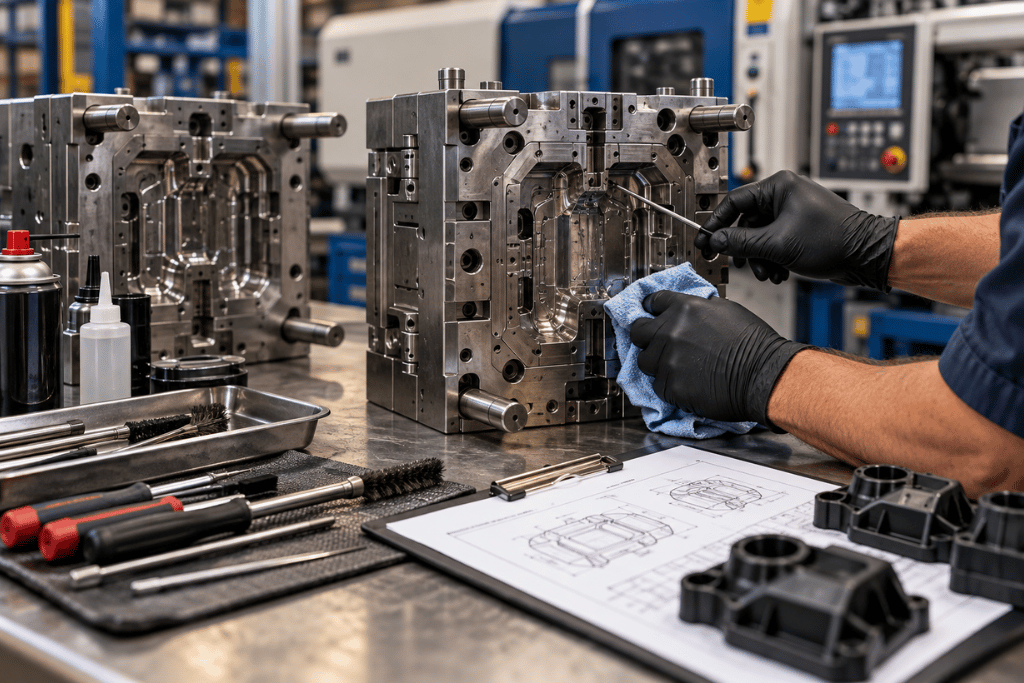
A mold is not just a piece of tooling that makes plastic parts. It is the foundation of the entire molding process. When the mold is clean, vented properly, maintained consistently, and supported by a strong process, production has a much better chance of staying repeatable. When mold maintenance is ignored, quality issues can creep in slowly until defects become part of the daily chaos parade.
Mold maintenance in injection molding helps protect part quality by preventing buildup, wear, vent blockage, flash, sticking, cosmetic defects, dimensional variation, and avoidable downtime. For OEMs and sourcing teams, maintenance is not just a shop-floor task. It is a production reliability strategy.
This guide explains what a mature preventive maintenance program looks like, why cleaning and venting matter, how polish schedules affect cosmetic parts, and how mold care connects directly to quality control.
Why Mold Maintenance Matters for Part Quality
Injection molds operate under heat, pressure, repeated cycles, resin flow, cooling, ejection, and mechanical movement. Over time, even a well-built tool can collect residue, experience wear, lose venting efficiency, or develop surface issues that affect molded parts.
When maintenance is inconsistent, defects may appear gradually. A part that ran well for months may start showing flash, drag marks, burns, sticking, dimensional drift, or inconsistent finish. These problems can be frustrating because they may not look like a tooling issue at first. Teams may chase process settings, material lots, or operator changes before realizing the mold itself needs attention.
Preventive care helps reduce that risk. It keeps injection mold tooling in production-ready condition and supports more stable output over the life of the program.
Common Quality Problems Linked to Poor Mold Maintenance
Many injection molding defects can be influenced by mold condition. Not every defect is caused by the tool, but mold wear, contamination, poor venting, or surface damage can make defects more likely.
Maintenance-related problems may include:
- Flash from worn shutoffs, parting line damage, or poor tool fit
- Burn marks from blocked or insufficient venting
- Sticking or drag marks from worn surfaces or poor release conditions
- Cosmetic defects from residue, scratches, or inconsistent polish
- Dimensional variation from tool wear or damaged critical features
- Short shots or fill issues caused by venting or flow restrictions
- Unexpected downtime from neglected moving components
The important thing is that these problems are often preventable. Mold maintenance gives the production team a way to catch issues before the parts begin tattling on the tool.
Preventive Cleaning: Small Work That Avoids Big Problems
Preventive cleaning is one of the most basic and valuable parts of mold maintenance. During production, molds can collect resin residue, gas deposits, dust, grease, oil, rust inhibitors, and material buildup. If that buildup stays in the tool, it can affect surface finish, venting, part release, and dimensional consistency.
Cleaning schedules should be based on the material being molded, part complexity, production volume, cosmetic requirements, and historical defect trends. Some materials leave more residue than others. Some tools have small details or textured surfaces that need more careful cleaning. Some applications require stricter cosmetic control and cannot tolerate even minor surface contamination.
A good cleaning program does not wait until a defect appears. It defines when cleaning happens, what areas are inspected, what products are used, and how the mold is protected before going back into production.
Venting: The Tiny Detail That Causes Big Defects
Venting allows trapped air and gases to escape as molten plastic fills the mold cavity. When vents are clean and properly maintained, the part fills more consistently. When vents become blocked or damaged, the process can develop burn marks, short shots, poor surface finish, weak areas, or inconsistent fill behavior.
Vents are easy to underestimate because they are small, but they are extremely important. A tool can look fine externally while vent performance quietly declines. That decline may show up as a process problem, even though the root cause is that air cannot escape properly.
For complex parts, thin-wall sections, long flow paths, or materials that gas during processing, vent maintenance becomes even more important. Keeping vents clean and within specification protects the process window and reduces the need for constant adjustment on the press.
Polish and Surface Maintenance for Cosmetic Parts
Cosmetic parts need special attention because surface condition matters. A small scratch, residue pattern, dull area, or damaged texture can transfer directly to the molded part. If the part is customer-facing, these defects may lead to rejection even when the part is functionally acceptable.
Polish schedules should match the part requirements. Not every tool needs frequent polishing, and over-polishing can create its own problems. The goal is controlled surface maintenance: enough care to protect appearance and part release, without changing critical geometry or finish in ways that affect consistency.
For textured or high-gloss parts, the maintenance team should understand which surfaces are cosmetic, which are functional, and which should not be altered without approval. A casual polish on the wrong feature can turn into a very shiny little disaster.
Moving Components Need Scheduled Attention
Many molds include moving components such as slides, lifters, ejector pins, cams, inserts, and mechanical actions. These features make complex part geometry possible, but they also introduce wear points that need routine inspection and lubrication.
If moving components are neglected, the tool may begin to stick, gall, misalign, or wear unevenly. This can create part defects, ejection issues, cycle interruptions, or more serious tool damage. Preventive care should include inspection of moving mechanisms, lubrication where required, review of wear surfaces, and confirmation that components return to the correct position during each cycle.
This is especially important for parts with tight fit requirements or complex geometry. When the tool action changes slightly, the molded part can change too.
Cooling System Maintenance Protects Repeatability
Cooling is one of the biggest drivers of cycle time, dimensional stability, and part quality. If cooling channels become restricted, scaled, corroded, or inconsistent, the mold may no longer cool evenly. That can contribute to warpage, dimensional drift, longer cycle times, or inconsistent part appearance.
Cooling maintenance may include checking flow, cleaning water lines, monitoring temperature consistency, and reviewing whether any hot spots are developing over time. This is not the glamorous part of molding, but it is the part that quietly decides whether production behaves or decides to start throwing chairs.
For parts where dimensional control matters, cooling stability should be treated as part of the quality system, not just a utility concern.
Maintenance and Injection Molding Quality Control
Mold maintenance and injection molding quality control should work together. Inspection data can reveal when a tool may need attention. If a dimension begins drifting, flash starts appearing, cosmetic marks repeat in the same location, or one cavity behaves differently from others, the maintenance plan should respond.
A mature quality program does not treat maintenance as separate from production performance. It connects inspection findings, process trends, tool history, and corrective actions. That connection makes it easier to identify whether a defect is caused by process settings, material variation, tool wear, venting, cooling, or another factor.
This is especially valuable for multi-cavity tools. If one cavity starts producing defects before the others, cavity-level inspection data can help isolate the issue quickly.
What a Preventive Mold Maintenance Program Should Include
A strong preventive maintenance program should be documented, consistent, and practical. It should not depend only on memory or emergency reaction. The goal is to create a maintenance rhythm that protects the tool and supports stable production.
A mold maintenance program may include:
- scheduled cleaning based on shot count, material, and part requirements
- vent inspection and cleaning
- surface inspection for scratches, residue, rust, or wear
- polish or texture maintenance when needed
- inspection and lubrication of moving components
- ejector system inspection
- cooling channel checks and cleaning
- parting line and shutoff inspection
- cavity-specific review for multi-cavity tools
- maintenance documentation and tool history tracking
The schedule should be realistic. Overly vague maintenance plans do not help anyone. Overly aggressive plans can waste time. The best plan is based on how the tool actually runs and what quality risks matter most.
Tool History Helps Prevent Repeat Problems
Tool history is one of the most useful parts of mold maintenance. When a team tracks what happened to the tool, when maintenance was performed, what defects occurred, and what corrective actions were taken, patterns become easier to see.
For example, if flash appears after a certain number of cycles, maintenance can be scheduled before that point. If vents block more quickly with a specific resin, cleaning frequency can be adjusted. If one cavity consistently needs attention, the team can investigate whether wear, cooling, venting, or alignment is involved.
Without tool history, every problem feels new. With tool history, the team can stop fighting the same little gremlin in different costumes.
How Mold Maintenance Supports Lead Time and Production Planning
Maintenance also affects lead time. A neglected tool may cause unexpected downtime, sampling delays, rejected parts, or emergency repairs. Those disruptions can make production schedules harder to manage and increase the risk of missed deliveries.
When maintenance is planned, production teams can schedule work more predictably. Tools can be cleaned, reviewed, and repaired before issues interrupt active orders. This is especially important for repeat production programs where customers rely on consistent supply.
If timing is critical, mold condition should be part of the schedule conversation. Hansen’s guide to injection molding lead time explains how tooling, sampling, approvals, resin sourcing, and production scheduling all affect realistic timelines.
Questions Buyers Should Ask About Mold Maintenance
OEMs and purchasing teams do not need to manage every detail of a supplier’s maintenance program, but they should understand how mold care is handled. This is especially important for long-term production parts, tight-tolerance components, cosmetic parts, and transferred tooling.
Useful questions include:
- How is preventive maintenance scheduled?
- Is maintenance based on shot count, calendar timing, material type, or defect history?
- How are vents inspected and cleaned?
- How are moving components inspected and lubricated?
- How is tool maintenance documented?
- How are recurring defects connected back to tooling review?
- How are transferred molds evaluated before production?
- How are customers notified if tool repair or modification is needed?
These questions help buyers understand whether the supplier is protecting long-term part quality or simply reacting when the tool starts complaining loudly.
Transferred Tooling Needs Extra Review
When an existing mold is moved from one supplier to another, maintenance review becomes even more important. A transferred tool may arrive with incomplete records, hidden wear, missing components, cooling restrictions, damaged surfaces, or outdated process assumptions.
Before quoting production on a transferred mold, the supplier should review the tool condition and identify any risks that could affect sampling, production, quality, or lead time. This may include checking parting lines, shutoffs, vents, ejector systems, slides, cooling channels, and critical cavity surfaces.
Skipping this review can lead to ugly surprises during sampling. The tool may technically run, but “technically runs” is not the same as “ready for repeatable production.” That phrase has fooled many a program, the sneaky little menace.
Preventive Care Protects the Full Program
Good mold maintenance protects more than the tool. It protects part quality, production schedules, customer confidence, and long-term cost. It helps prevent defects before they become shipments, and it gives production teams better control over repeatability.
For OEMs, the takeaway is simple: if the mold matters to the part, maintenance matters to the program. Preventive cleaning, venting, surface care, cooling checks, and tool history all contribute to better production outcomes.
If your team is reviewing a molded part program or transferred tool, Hansen Plastics can help evaluate tooling readiness, production risks, and quality requirements. Explore Hansen’s injection mold tooling capabilities or learn more about plastic injection molding support for repeatable production programs.