



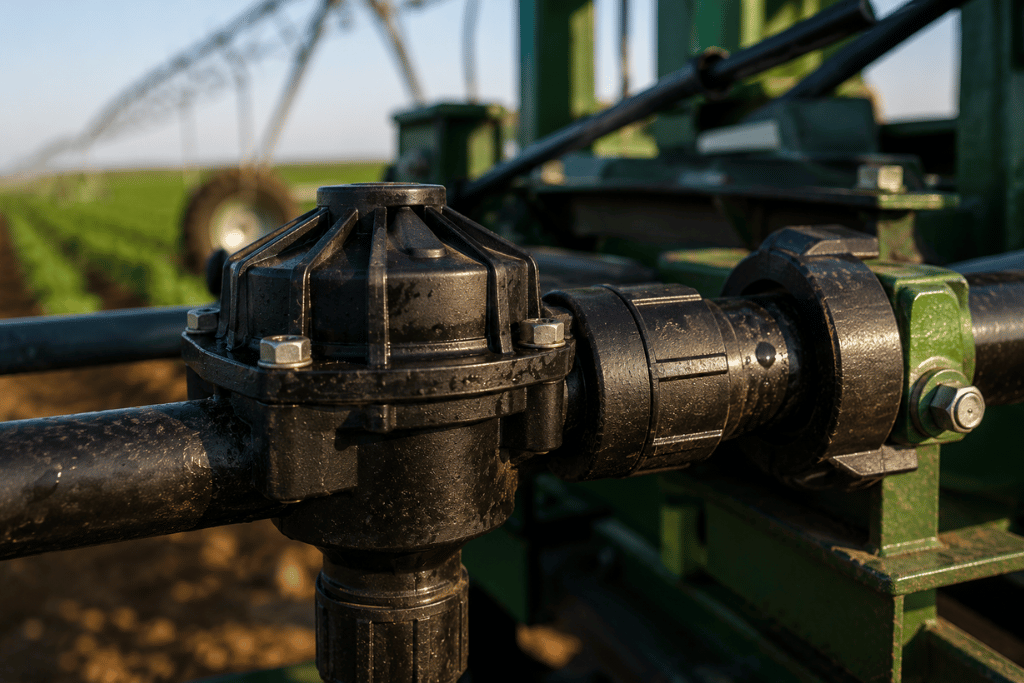
Outdoor agricultural parts do not get an easy life. They sit in direct sun, deal with heat during the day and cooler temperatures at night, encounter water, dirt, fertilizer, pesticides, cleaning agents, and then get handled by people who are usually trying to keep equipment moving, not delicately babysit a plastic component. Cute little field nightmare, basically.
That is why sourcing UV resistant plastic components for agriculture requires more than asking for a “durable plastic.” UV exposure is only one part of the performance picture. To get a material and design that hold up outdoors, buyers need to document the full operating environment: sun exposure, temperature cycles, chemical contact, moisture, mechanical stress, and expected service life.
This guide explains what to specify when sourcing outdoor agricultural plastic solutions, so your supplier can recommend the right material, tooling strategy, and design approach before production begins.
Why UV Resistance Matters in Agricultural Plastics
UV exposure can slowly change how plastic behaves. A component may look fine during early testing, then become brittle, faded, cracked, or weaker after months or years outdoors. For agricultural applications, that matters because many plastic parts are expected to survive multiple seasons with minimal maintenance.
UV degradation can affect:
- Impact strength
- Flexibility and toughness
- Surface appearance and color stability
- Crack resistance around stress points
- Long-term fit and sealing performance
The risk is especially high for components exposed to full sun, repeated handling, pressure cycling, or chemical contact. UV does not always act alone. It often combines with heat, load, and environmental exposure to make failures happen faster.
Start by Defining the Outdoor Use Case
The first step is to clearly explain where the part will live and how it will be used. A plastic cover mounted on a piece of equipment is not the same as an irrigation fitting exposed to constant water pressure. A greenhouse component near filtered sunlight is not the same as a field component sitting in direct sun all season.
Before selecting material, document the part’s real environment. For example, clarify whether the component is used in open-field agriculture, greenhouse operations, irrigation systems, equipment housings, protective covers, brackets, or fluid handling assemblies. The more specific the use case, the better the material recommendation.
If the component is part of an irrigation system, it may also help to review design considerations for plastic irrigation components, where UV exposure, chemical resistance, sealing surfaces, and fit consistency all affect long-term reliability.
What to Document About UV Exposure
UV exposure should be specified in practical terms, not just as “outdoor use.” Outdoor use can mean many different things. A part may be exposed only during certain seasons, partially shaded by equipment, protected by a housing, or fully exposed to sun for years.
Useful details include:
- Full sun, partial shade, or protected location
- Seasonal use vs year-round exposure
- Expected service life, such as 3, 5, or 10 years
- Whether appearance matters or only mechanical performance matters
- Color expectations and fading tolerance
These details help your supplier decide whether UV-stabilized materials, additives, color choices, or specific resin families should be considered. A black utility component with no cosmetic requirement may have a different material strategy than a visible housing where color fade or chalking would be unacceptable.
Temperature Cycles Can Be Just as Important as Sun Exposure
Outdoor agriculture parts rarely experience one stable temperature. They heat up in the sun, cool down overnight, and may sit in storage during colder months. These temperature cycles affect stiffness, toughness, creep, and dimensional stability.
For plastic parts for agricultural equipment, temperature cycling can contribute to cracking near fasteners, loosening at mating interfaces, or dimensional drift in parts that need to fit consistently. A material that performs well at room temperature may become brittle in cold conditions or soften under heat and load.
When specifying outdoor performance, include:
- Expected high and low temperature ranges
- Whether heat exposure is constant or intermittent
- Whether the part is near engines, pumps, motors, or enclosed equipment
- Storage conditions during off-season periods
- Whether freeze-thaw cycles are expected
Temperature information also supports better injection mold design decisions, because thermal expansion, shrink behavior, and tolerance planning can affect how the part performs in assembly.
Chemical Contact Changes the Material Conversation
Agricultural environments often include fertilizer, pesticides, herbicides, oils, fuels, hydraulic fluids, cleaning agents, and treated water. Even when chemical contact is not constant, repeated splash exposure or residue buildup can affect long-term durability.
The most annoying failure mode here is environmental stress cracking. That happens when chemical exposure combines with mechanical stress. A part may be fine under load and fine with light chemical exposure separately, but the combination can cause cracking over time. Tiny betrayal in polymer form.
To reduce that risk, document:
- Specific chemicals or product categories
- Exposure type: splash, wipe, vapor, residue, or immersion
- Frequency and duration of exposure
- Temperature during exposure
- Whether the part is under load while exposed
This is especially important for fittings, threaded components, covers, clamps, housings, and components that remain under stress during operation.
Mechanical Stress, Impact, and Wear Still Matter
UV resistance is not enough if the part also sees vibration, impact, or abrasion. Many outdoor agricultural parts are mounted to equipment, handled during maintenance, exposed to soil and grit, or connected to assemblies that cycle under pressure.
Stress-heavy features can include bosses, ribs, snap fits, threaded areas, sealing interfaces, corners, and plastic-to-metal contact points. If these features are not designed carefully, UV and temperature aging can make them more vulnerable over time.
When specifying outdoor components, explain how the part is loaded. Does it support weight? Does it experience vibration? Is it struck by debris? Does it rub against another part? Does it need to survive repeated assembly and disassembly? These details allow the supplier to think beyond basic material selection and review geometry for long-term durability.
Color, Appearance, and Surface Finish Should Be Defined Early
Outdoor performance is not always purely mechanical. Some components need to maintain a consistent appearance, especially if they are visible on finished equipment or customer-facing products. UV exposure can cause fading, chalking, gloss changes, and surface degradation depending on the resin, pigment, and additives used.
If appearance matters, specify the acceptable level of color change and whether surface finish needs to remain consistent over time. If appearance does not matter, say that too. It gives the supplier more flexibility to prioritize mechanical performance and cost.
For programs where material choice is still open, Hansen’s guide to plastic injection molding materials can help compare resin options based on chemical resistance, temperature, impact, cost, and appearance.
Outdoor Parts Need Realistic Service Life Targets
“Durable” is not a specification. It is a wish wearing a tiny hard hat. A better approach is to define the expected service life and the conditions the part must survive during that period.
For example, a temporary seasonal part may not need the same material strategy as a component expected to remain outdoors for years. A part that can be inspected and replaced easily may carry a different risk profile than a hidden component whose failure causes downtime.
Useful service life questions include:
- How many seasons should the part last?
- Is failure mainly a maintenance issue or a safety/operational issue?
- Will the part be replaced preventively or only after failure?
- Does the part need to maintain appearance, fit, and function for the full service life?
- What environmental conditions define “end of life”?
Clear service life expectations help align material selection, tooling strategy, inspection plans, and cost targets.
How Repeatable Molding Supports Outdoor Performance
Even the right material can underperform if the molding process is not stable. Outdoor agricultural components often rely on consistent wall thickness, controlled shrink, predictable fit, and strong molded features. Process variation can create weak spots, dimensional drift, or internal stress that becomes a problem later in the field.
This is why plastic injection molding partners should evaluate both material and process. A strong program considers resin behavior, part geometry, gating, cooling, inspection, and critical-to-fit dimensions together.
For outdoor applications, repeatability helps protect:
- Sealing surfaces and mating features
- Fastener bosses and mounting points
- Threaded or snap-fit geometry
- Wall thickness consistency
- Dimensional stability over production runs
If the part is produced at scale, consistency is not a luxury. It is the thing that keeps one batch from behaving differently than the next.
RFQ Checklist for UV Resistant Agricultural Components
To get a better quote and a stronger material recommendation, include the following information in your RFQ:
- Part function and failure consequence
- CAD files and drawing revision
- Full sun, partial shade, or protected outdoor exposure
- Expected service life and seasonality
- Operating and storage temperature range
- Chemical contact list and exposure type
- Moisture, humidity, washdown, or soil contact
- Impact, vibration, wear, or load requirements
- Critical-to-fit and critical-to-function dimensions
- Color, surface finish, and appearance expectations
- Annual volume and production ramp plan
- Packaging requirements to protect functional surfaces
If you are still defining requirements, Hansen’s guide on custom plastic manufacturing for agriculture provides a broader sourcing checklist for environment, chemicals, UV exposure, impact needs, tolerances, and annual volumes.
Outdoor Performance Starts With Better Specifications
The best UV resistant plastic components for agriculture are not selected by guessing a resin and hoping the sun behaves. They are engineered from clear requirements: UV exposure, temperature cycles, chemical contact, mechanical stress, appearance needs, and expected service life.
When those details are documented early, suppliers can recommend materials, additives, mold design strategies, and process controls that support long-term outdoor performance. That means fewer cracked parts, fewer fit problems, fewer field failures, and a more reliable path from quote to production.
If your team is sourcing outdoor plastic parts for agricultural equipment, Hansen Plastics can help evaluate material options, manufacturability, and performance requirements before tooling begins. Explore Hansen’s plastic injection molding for agriculture capabilities or connect with the team to review your next outdoor component.