



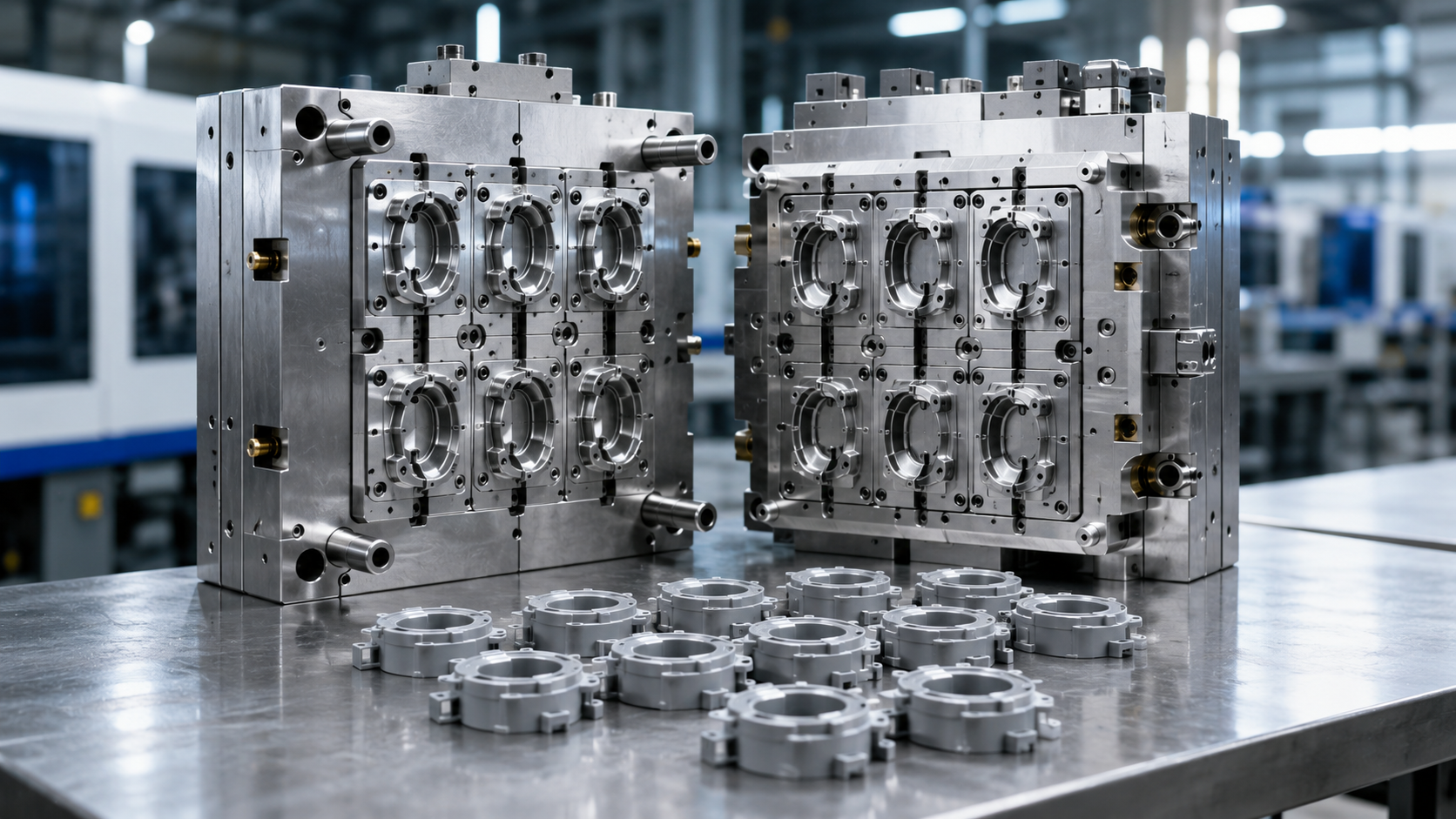
At a certain production volume, the question changes from “Can we mold this part?” to “How efficiently can we mold this part at scale?” That is where a multi-cavity injection mold becomes part of the conversation.
A multi-cavity tool can produce more than one part per molding cycle, which can improve throughput and reduce unit cost when the program volume supports it. But more cavities also mean higher tooling investment, more complex balancing, more quality planning, and a stronger need for process discipline. In other words, it can be brilliant or it can become a very expensive metal octopus. Depends how well the program is planned.
This guide explains how cavitation affects cycle time, quality, throughput, and injection molding cost, and what teams should watch for before scaling from a single-cavity or lower-cavity tool into a higher-output production strategy.
What Is a Multi-Cavity Injection Mold?
A multi-cavity injection mold is a tool designed to produce multiple identical parts in one molding cycle. Instead of one cavity filling, cooling, and ejecting one part per shot, the tool contains several cavities that run at the same time.
For example, a four-cavity tool can produce four parts per cycle. An eight-cavity tool can produce eight parts per cycle. In theory, increasing cavity count increases output. In practice, the economics depend on whether the tool can fill consistently, cool evenly, eject reliably, and maintain quality across every cavity.
This is why cavitation is not just a math decision. It is a tooling, processing, quality, and business decision wrapped into one shiny steel burrito.
Why Cavitation Affects Unit Economics
The main advantage of multi-cavity tooling is that it spreads machine time across more parts. If cycle time stays similar, producing more parts per shot can reduce the manufacturing cost assigned to each part. That can be especially valuable for high-volume programs where small changes in cycle efficiency create meaningful cost differences over the life of the tool.
However, the upfront injection mold tooling cost is usually higher for multi-cavity tools. The mold is more complex, requires more machining, may need more advanced runner and cooling strategies, and often demands tighter tool build precision to keep cavities balanced.
The decision becomes a tradeoff: higher tooling investment now in exchange for lower unit cost later. That tradeoff only makes sense when volume, demand stability, part design, and quality requirements support the investment.
When Multi-Cavity Tooling Usually Makes Sense
A multi-cavity tool is often the right move when demand is stable enough to justify the investment and the part design is mature enough that major changes are unlikely. If a team expects long-term production and wants to improve throughput, higher cavitation can help reduce unit cost and support more efficient scheduling.
Multi-cavity tooling is commonly considered when:
- Annual volume is high and predictable
- The design is stable and unlikely to change significantly
- Unit cost reduction is a major program priority
- The part is small or moderate in size relative to press capacity
- Quality requirements can be controlled cavity to cavity
- Production demand requires higher throughput from the same press time
The key word is “stable.” If the design is still moving around like it drank three espressos, a high-cavity tool may lock in risk too early.
When Lower Cavitation May Be Smarter
More cavities are not automatically better. Lower cavitation may be the smarter strategy when the product is still in launch, when demand is uncertain, or when the part has features that may require design refinement after sampling.
Lower-cavity tools can also make sense for parts with challenging geometry, tight tolerance features, or material behavior that needs to be better understood before scaling. In these cases, a single-cavity or lower-cavity tool may support faster learning, easier adjustments, and lower upfront risk.
This is why some programs move in stages: validate the design, prove demand, stabilize the process, then scale cavitation once the economics are clearer. Hansen’s guide to injection mold tooling types covers this broader tooling strategy and how cavity count fits into launch and scale decisions.
How Cavitation Affects Cycle Time
Increasing cavity count does not always mean cycle time stays exactly the same. A larger or more complex tool may require more attention to filling, packing, cooling, and ejection. If the runner system, cooling layout, or part geometry creates imbalance, cycle time may need to be adjusted to maintain part quality.
Cycle time can be influenced by:
- Material flow length and runner balance
- Cooling consistency across cavities
- Part wall thickness and geometry
- Gate type and gate location
- Ejection reliability across all cavities
- Press capability and shot size
A multi-cavity tool only improves economics when it produces more acceptable parts per hour, not just more parts per shot. If higher cavitation creates more scrap, longer cycles, or more downtime, the expected savings can disappear.
Throughput: The Real Goal of Higher Cavitation
The purpose of higher cavitation is throughput. A well-designed multi-cavity mold can help a manufacturer produce more parts in less machine time, which can improve capacity planning and reduce pressure on scheduling.
This matters for programs with ongoing demand, seasonal spikes, or tight delivery windows. If one tool can support higher output without sacrificing quality, the production system becomes more efficient. That can reduce the need for extra shifts, additional machines, or emergency production runs.
But throughput should always be viewed alongside quality. A tool that runs fast but produces inconsistent parts is not efficient. It is just chaotic at a higher speed, which is not the flex anyone needs.
Quality Risk: Cavity-to-Cavity Variation
One of the biggest challenges in a multi-cavity injection mold is cavity-to-cavity consistency. Every cavity needs to produce parts that meet the same dimensional, cosmetic, and functional expectations. If one cavity fills differently, cools differently, or wears faster, the program can experience random-looking defects that are hard to trace without proper controls.
Cavity-to-cavity variation may affect:
- Critical dimensions
- Part weight
- Surface appearance
- Fit with mating components
- Sealing performance
- Assembly force or alignment
This is where injection molding quality control becomes essential. Multi-cavity production benefits from cavity identification, cavity-specific sampling, and trend monitoring so issues can be isolated before they affect an entire production run.
Runner Strategy Matters More as Cavities Increase
As cavity count increases, runner strategy becomes more important. The tool has to deliver molten resin evenly so each cavity fills and packs consistently. If flow is unbalanced, some cavities may overpack while others underpack, creating dimensional variation, flash, sink, short shots, or cosmetic differences.
Both hot runner and cold runner systems can work in multi-cavity tooling, but each brings different tradeoffs. A hot runner may reduce runner scrap and support higher cavitation efficiently. A cold runner may be simpler and more flexible, depending on resin, part design, and production needs.
If runner strategy is still being evaluated, Hansen’s guide to hot runner vs cold runner tooling can help frame how scrap, cycle time, maintenance, resin suitability, and part design affect the decision.
Press Selection and Machine Fit
Multi-cavity tools also put more demand on the press. The machine must have the right clamp force, shot capacity, injection pressure, and physical mold fit to run the tool consistently. A tool may look good in design, but if it is paired with the wrong press, quality and repeatability can suffer.
Press selection affects whether the tool can fill consistently, pack properly, hold the mold closed, and maintain stable production conditions over time. For higher cavitation programs, the machine-tool match becomes even more important because small process instability can multiply across cavities.
For more background on tonnage, shot size, and machine fit, review Hansen’s guide to plastic injection molding press basics.
Material Selection and Cavitation
Material behavior can also influence whether a multi-cavity strategy is practical. Some resins flow easily and fill multi-cavity layouts consistently. Others are more sensitive to shear, moisture, temperature, residence time, or shrink variation. Filled materials may introduce additional considerations because fiber orientation and shrink behavior can affect warpage and dimensional control.
When scaling to higher cavitation, teams should review resin behavior alongside the tool concept. A material that worked well in a single-cavity or prototype tool may still need additional validation in a production tool with more cavities, different runner layout, and different thermal behavior.
How Multi-Cavity Tools Affect Inspection Planning
Inspection planning changes when a tool has multiple cavities. It is not enough to measure a few random parts and assume every cavity behaves the same. If cavity-specific issues exist, blended sampling can hide them until they become expensive.
A stronger quality plan may include:
- Cavity identification on molded parts
- First article checks by cavity
- In-process sampling by cavity during production
- Trend monitoring on critical-to-quality dimensions
- Reaction plans for cavity-specific drift
- Tool maintenance records tied to cavity performance
This approach helps the team catch whether one cavity is drifting, wearing, flashing, or producing fit issues before the problem spreads into shipment-level defects.
What to Ask Before Investing in a Multi-Cavity Tool
Before approving a multi-cavity injection mold, engineering and sourcing teams should ask questions that connect tooling strategy to production reality:
- What annual volume justifies this cavity count?
- How stable is the current part design?
- What runner strategy is recommended and why?
- How will the tool be balanced across cavities?
- What press size and shot capacity are assumed?
- How will cavity-to-cavity variation be monitored?
- Which dimensions are critical-to-quality or critical-to-fit?
- What maintenance plan is needed to protect long-term repeatability?
- What happens if demand grows beyond this cavity count?
These questions help make the cavitation decision less mystical and more financially grounded. As thrilling as “just make more cavities” sounds, it is not exactly a strategy. It is a sentence wearing a fake mustache.
The Break-Even Conversation
A multi-cavity tool usually needs a break-even review. The team should compare higher tooling cost against expected savings from lower unit cost, improved throughput, reduced machine time, and production efficiency. If the volume is high enough and the design is stable, higher cavitation can make excellent financial sense.
If demand is uncertain, the break-even point may be too far away or too risky. In that case, a lower-cavity tool may be better until the program proves itself. The best decision is not always the lowest unit cost on paper. It is the tooling plan that gives the program the right balance of cost, flexibility, and production confidence.
Multi-Cavity Strategy Is Scaling Strategy
A multi-cavity injection mold can improve unit economics when production demand is stable, the design is mature, the tool is properly balanced, and quality controls are built around cavity-level performance. It can reduce unit cost, increase throughput, and support efficient long-term production.
But it also raises the stakes. More cavities mean more opportunities for variation, more tooling complexity, and more need for disciplined process control. The smartest programs treat cavitation as part of a scaling strategy, not just a way to make the quote look better.
If your team is evaluating a multi-cavity tool, Hansen Plastics can help review part geometry, volume expectations, runner strategy, press fit, and quality planning before tooling begins. Explore Hansen’s injection mold tooling capabilities or learn more about plastic injection molding support for production programs.