



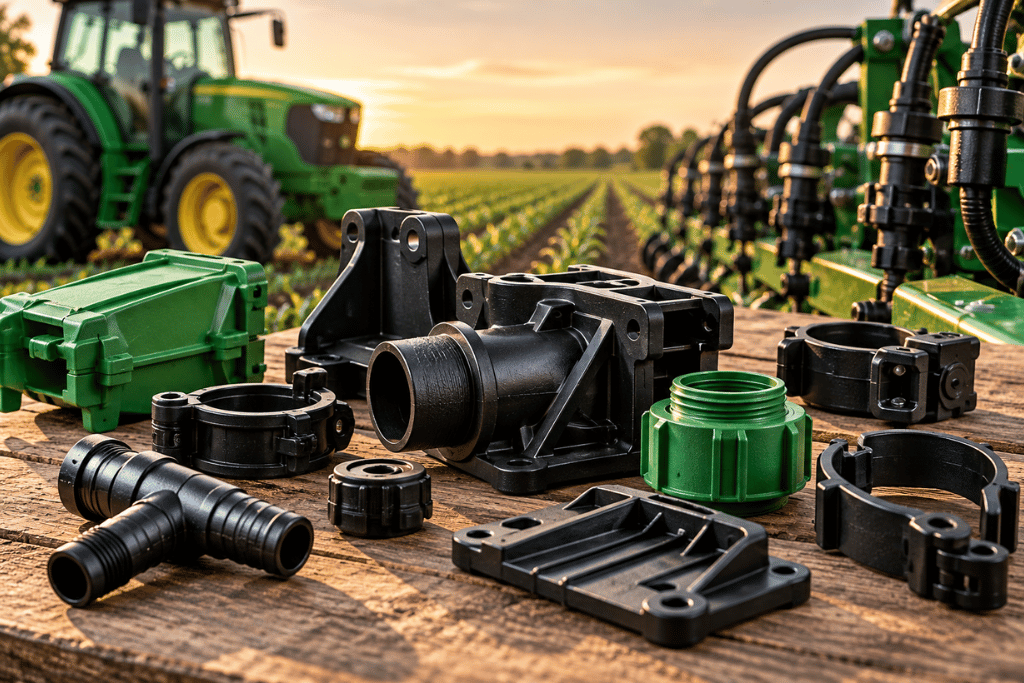
Outdoor agricultural parts have to do more than survive the first installation. They need to keep fitting, sealing, fastening, aligning, and functioning after sun exposure, temperature swings, vibration, moisture, fertilizer residue, and field handling. That is where agricultural injection molding becomes especially valuable: it helps turn a part design into repeatable production, so components behave consistently from run to run.
Repeatable fit matters because many agricultural parts are not used alone. They connect to equipment frames, irrigation lines, housings, brackets, covers, clamps, seals, fasteners, and mating components. If the fit drifts, the problem can show up as leaks, rattles, loose assemblies, cracked parts, difficult repairs, or field downtime wearing muddy boots and a bad attitude.
This guide explains how injection molding supports repeatability in outdoor agricultural parts, what buyers should document before quoting, and how to reduce variation in parts that need to perform consistently across seasons.
Why Repeatable Fit Matters in Agricultural Parts
Agricultural environments are not gentle. Outdoor parts may see UV exposure during the day, cool temperatures at night, vibration during operation, dust and grit during field use, and chemicals from fertilizers, pesticides, oils, fuels, or cleaning agents. When those conditions combine, small fit problems can become larger reliability problems.
For example, a slightly loose fitting may leak after pressure cycling. A bracket with inconsistent hole alignment may create installation delays. A cover that warps in heat may stop sealing properly. A plastic-to-metal interface that changes dimension over time may create vibration, wear, or cracking around fasteners.
This is why repeatable fit should be treated as a design and production requirement, not just a nice little bonus that shows up if everyone behaves.
Injection Molding Supports Repeatability at Scale
One of the main benefits of plastic injection molding services is the ability to produce consistent parts once the mold, material, and process are properly validated. Compared with processes that rely more heavily on manual shaping or post-processing, injection molding can deliver tighter control over part geometry, surface features, and critical dimensions.
That repeatability depends on several factors working together: stable tooling, appropriate material selection, controlled processing, realistic tolerances, and quality checks focused on the right features. The mold gives the part its shape, but the full process determines whether that shape repeats reliably over time.
For outdoor agricultural applications, this matters because the parts often need to fit into larger systems. The goal is not just to make one good part. The goal is to keep making parts that fit and perform the same way across production runs.
Start by Defining What “Fit” Means
Before sourcing plastic parts for agricultural equipment, buyers should define what fit actually means for the component. “Good fit” is not specific enough. Is the part sealing? Snapping into place? Holding a fastener? Aligning with metal? Supporting tubing? Maintaining clearance around a moving component?
Useful fit requirements may include:
- hole alignment and mounting locations
- sealing surfaces and gasket compression
- thread engagement or torque range
- snap-fit force or retention
- tube, hose, or pipe engagement
- flatness, roundness, or part-to-part alignment
- clearance around moving components
Once the fit requirement is defined, the molder can identify which dimensions are critical and which areas have more flexibility. That distinction helps protect function without over-tightening every tolerance on the drawing.
Outdoor Conditions Can Change Fit Over Time
Outdoor performance is not only about whether a part looks good when it leaves the factory. Sunlight, heat, cold, moisture, and chemical exposure can affect how plastic behaves over time. Some materials may become brittle under UV exposure. Others may creep under load, shift dimensionally with temperature, or lose toughness after repeated environmental exposure.
For parts that need repeatable fit outdoors, teams should document the full environment. That includes sun exposure, seasonal temperature swings, moisture, soil contact, chemical exposure, and expected service life. Hansen’s guide to UV resistant plastic components for agriculture explains how to specify outdoor exposure, temperature cycles, chemical contact, and expected performance life.
If these conditions are not documented early, the supplier may select a material or tolerance strategy based on incomplete assumptions. That is how a part that fits beautifully in sampling can later turn into a field gremlin with a torque wrench.
Material Selection Affects Dimensional Stability
Material choice has a direct impact on fit consistency. Different resins shrink differently, respond differently to moisture, handle heat differently, and vary in stiffness, toughness, and creep resistance. A material that is excellent for impact may not be the best for tight dimensional control. A material that holds shape well may need extra review for low-temperature toughness or chemical exposure.
For outdoor agricultural parts, material selection should consider:
- UV stability
- temperature range
- chemical resistance
- impact and vibration exposure
- creep under load
- wear and abrasion
- dimensional stability
Hansen’s plastic injection molding materials guide is a useful resource for comparing common resin tradeoffs based on chemical resistance, temperature, impact, cost, and appearance.
Tolerances Should Protect the Right Features
Repeatable fit does not mean every dimension needs to be extremely tight. In fact, over-tight tolerances can increase tooling complexity, inspection burden, scrap risk, and cost without improving performance. The better strategy is to define critical-to-fit and critical-to-function dimensions clearly.
For agricultural components, critical dimensions might include a sealing diameter, fastener hole location, snap feature, O-ring groove, tube connection, or mating surface. Other dimensions may be less sensitive and can allow more variation without affecting the part’s performance.
This approach helps balance function and manufacturability. It gives the molding team a clear target for process control while avoiding unnecessary cost in areas that do not affect field performance.
Tooling and Mold Design Influence Repeatability
Repeatable fit starts with a mold that is designed for the part’s geometry, material, and production expectations. Gate location, cooling strategy, venting, ejection, shrink planning, parting line placement, and cavity layout can all influence whether parts stay consistent.
If a part has tight fit requirements, tooling decisions should be reviewed before the mold is built. A design that looks acceptable in CAD may still create warpage, sink, dimensional drift, or difficult ejection if it is not reviewed for molding behavior.
For complex outdoor parts, an early DFM review can help identify:
- areas likely to warp or shrink unevenly
- thick sections that may create sink or internal stress
- features that need better draft or support
- gate locations that may affect fit or cosmetic surfaces
- critical interfaces that need tighter process control
For more detail on design choices that affect molded part quality, see Hansen’s guide to injection mold design.
Process Control Keeps Fit Consistent Over Production Runs
Even with good tooling and material selection, the molding process has to stay stable. Fill, pack, hold, cooling, material drying, mold temperature, and press setup all affect final dimensions. If the process drifts, the part can drift too.
For outdoor agricultural parts that need repeatable fit, production teams should control the process around the features that matter most. That may include monitoring critical dimensions, tracking cavity-level variation, reviewing process parameters, and responding quickly when measurements begin trending toward a limit.
This is where injection molding quality control supports repeatability. Inspection plans, sampling, SPC thinking, and production data can help confirm that parts remain consistent beyond the first approved sample.
Multi-Cavity Tools Need Cavity-to-Cavity Control
Agricultural parts often need to be produced at meaningful volumes, and that may lead to multi-cavity tooling. Multi-cavity molds can improve throughput and unit economics, but they also require careful control because each cavity must produce parts that fit the same way.
If one cavity produces a slightly different dimension, the issue can look random in assembly. Some parts fit perfectly. Others are too tight, too loose, or inconsistent. Without cavity identification and cavity-specific sampling, that variation can be difficult to trace.
When fit matters, cavity-to-cavity consistency should be part of the quality plan. The team should know which features are critical, how they are measured, and how variation will be monitored across cavities and production runs.
What to Document Before Quoting Outdoor Agricultural Parts
To get accurate recommendations and reliable production results, buyers should provide a practical application profile. The supplier needs to understand how the part will be used, what it connects to, and what conditions it needs to survive.
Include the following in the RFQ:
- part function and failure consequence
- CAD files and drawing revision
- mating components and assembly method
- critical-to-fit and critical-to-function dimensions
- seal type, torque range, insertion force, or snap-fit requirements
- UV exposure and expected outdoor service life
- operating and storage temperature range
- chemical exposure, including fertilizers, oils, fuels, or cleaners
- impact, vibration, wear, or load requirements
- annual volume and seasonal demand pattern
- inspection, documentation, or approval requirements
If your team is still organizing requirements, Hansen’s guide to custom plastic manufacturing for agriculture provides a broader checklist for documenting environment, chemicals, UV exposure, impact needs, tolerances, and annual volumes.
Repeatable Fit Supports Better Field Reliability
Outdoor agricultural parts need to survive more than one clean assembly in a controlled environment. They need to keep fitting and functioning through seasons of sun, cold, moisture, chemicals, handling, repair, and vibration. Injection molding supports that goal by enabling repeatable production when the design, material, tooling, process, and quality plan are aligned.
For OEMs and agricultural equipment teams, the strongest results come from documenting requirements early and treating fit as a performance requirement. When suppliers understand how the part is used and what features control function, they can recommend better materials, smarter tooling strategies, and more focused quality checks.
If your team is developing outdoor agricultural plastic solutions, Hansen Plastics can help review part design, material options, fit requirements, tooling strategy, and production planning. Explore Hansen’s agricultural injection molding capabilities or learn more about custom plastic injection molding support for repeatable production parts.