



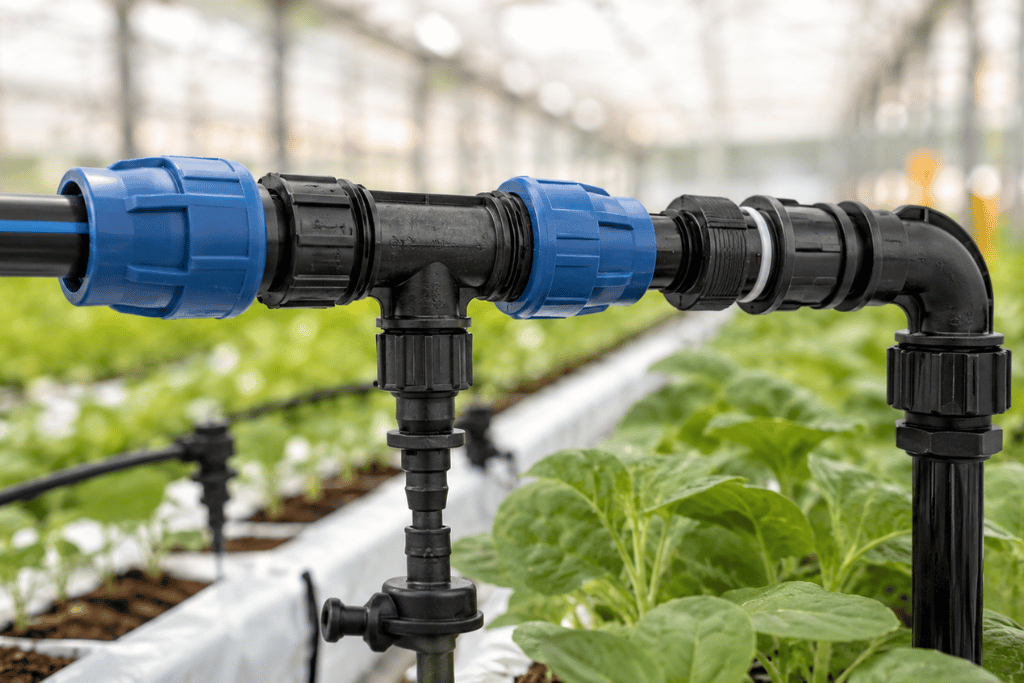
Greenhouse irrigation systems depend on repeatability. Every connector, fitting, emitter housing, valve body, coupling, and seal interface has to assemble correctly, hold pressure, and stay aligned through humidity, temperature shifts, chemical exposure, and ongoing maintenance. When one component fits inconsistently, the problem rarely stays small. A slight mismatch can become a leak, a loose assembly, a cracked fitting, or a pressure loss that affects the entire irrigation zone.
That is why fit consistency is one of the most important requirements for greenhouse irrigation components. In greenhouse environments, parts are often installed in long runs, assembled quickly, and expected to perform through repeated wet/dry cycles. If molded components vary too much from batch to batch or cavity to cavity, assembly becomes unpredictable, and reliability suffers.
This guide explains how repeatable molding helps prevent leaks and misalignment in greenhouse irrigation assemblies, and what buyers should define when sourcing agricultural plastic components for irrigation systems.
Why Greenhouse Irrigation Assemblies Are So Sensitive to Fit
Greenhouse irrigation systems are different from general outdoor irrigation in one important way: the environment is controlled, but the operating conditions are still demanding. Components may not see the same open-field abuse as outdoor fittings, but they often experience constant humidity, warm temperatures, fertigation chemicals, repeated handling, and tight spacing within irrigation layouts.
That combination makes assembly fit critical. If a fitting is too loose, it may leak or separate under pressure. If it is too tight, installers may force the assembly, creating stress around threads, barbs, or sealing surfaces. If the part is slightly warped, it can misalign tubing or compromise seal compression. None of these issues are dramatic at first, which is what makes them annoying little goblins. They show up later as maintenance calls, uneven watering, and replacement work.
For plastic greenhouse components, fit consistency is not just a quality preference. It is directly tied to uptime, water control, and labor efficiency.
How Poor Fit Turns Into Leaks
Leaks often begin at the interface between two parts: an O-ring groove, threaded fitting, push-to-connect feature, barb, gasket face, or compression-style connection. If that interface is not molded consistently, the assembly may pass an initial check but fail after pressure cycling or temperature changes.
Common leak-related fit issues include:
- O-ring grooves that do not hold consistent compression
- Threads that are too tight, too loose, or inconsistent across cavities
- Sealing faces affected by warpage, flash, or parting line variation
- Barbed features that do not grip tubing evenly
- Connector geometry that changes enough to create misalignment
The risk is not only the first leak. A poorly fitting component can also make installers compensate by over-tightening, pushing harder, or reworking the assembly in the field. That extra force can create stress points that later become cracks. This is why fit consistency and leak prevention need to be considered together.
Repeatable Molding Helps Keep Assemblies Predictable
Repeatable molding means the process produces parts that behave the same way from shot to shot, run to run, and cavity to cavity. That consistency depends on more than the mold itself. It requires the right material, stable processing, controlled cooling, properly defined tolerances, and quality checks focused on critical features.
For greenhouse irrigation assemblies, repeatable molding helps protect:
- Dimensional stability at sealing and mating features
- Consistent tubing engagement and insertion force
- Reliable thread fit and assembly torque
- Alignment between connected components
- Reduced risk of leaks caused by variation
This is one reason working with an experienced plastic injection molding partner matters. The part is not just being “made.” It is being controlled around the features that decide whether the system assembles and performs correctly.
Material Behavior Can Affect Fit Over Time
Material selection plays a major role in fit consistency. A resin may mold well initially but still create problems if it creeps under load, absorbs moisture, shifts dimensionally with temperature, or becomes brittle under UV and chemical exposure. In greenhouse irrigation, where humidity and fertigation chemicals are common, these material behaviors cannot be ignored.
For example, a component under constant compression may slowly deform if the resin is not appropriate for the load and temperature. A threaded fitting may loosen over time if creep is not considered. A sealing surface may lose performance if the material is too sensitive to chemical exposure. These issues are often misdiagnosed as “bad assembly” when the real problem is material and design mismatch.
If resin choice is still open, it can help to review material options alongside the system requirements. Hansen’s guide to plastic injection molding materials is a useful companion topic for teams comparing chemical resistance, temperature performance, impact, cost, and appearance.
Design Details That Improve Assembly Fit
Fit consistency starts in design. A supplier can control a process well, but if the part geometry is unstable, the process will always be fighting the design. For greenhouse irrigation parts, design decisions around wall thickness, ribs, sealing surfaces, parting lines, and gate location all influence how consistently the part molds.
Good design practices include keeping wall thickness as consistent as possible, avoiding sharp transitions near stress-heavy features, and protecting sealing surfaces from high-risk parting line or flash locations. For parts with threads, barbs, or press-fit features, the geometry should support repeatable assembly without requiring excessive installation force.
A detailed injection mold design review can help identify fit risks before tooling begins. This is especially important when an irrigation component must seal, align, or connect with parts supplied by another manufacturer.
Critical-to-Fit Dimensions Should Be Defined Early
Not every dimension on a greenhouse irrigation component needs the same level of control. Over-tightening tolerances across the entire part can drive unnecessary cost. Under-defining critical features can create assembly failures. The better approach is to identify critical-to-fit dimensions early and make sure the inspection plan is built around them.
Critical-to-fit dimensions may include:
- O-ring groove width, depth, and diameter
- Thread profile and pitch-sensitive features
- Barb diameter and retention geometry
- Tube insertion depth and stop features
- Flatness or roundness at sealing surfaces
- Connector alignment points within larger assemblies
Once those features are defined, the molder can build process controls and inspection checks around what actually protects assembly performance. That is much better than measuring everything equally and hoping the right things stay stable.
Why Cavity-to-Cavity Consistency Matters
Many irrigation components are produced in multi-cavity molds to support volume and cost targets. Multi-cavity production can be efficient, but it also creates a specific quality challenge: every cavity must produce parts that fit and function the same way.
If one cavity runs slightly different from the others, that variation can create random assembly problems. The line might receive mostly good parts with occasional fittings that feel too tight, leak sooner, or do not align correctly. That kind of inconsistency is particularly frustrating because it can be hard to trace without cavity-level data.
For high-volume plastic irrigation system components, quality planning should consider cavity identification, cavity-specific sampling, and trend monitoring on critical-to-fit features. This is where injection molding quality control becomes more than a final inspection step. It becomes a system for protecting repeatability.
Assembly Testing Should Reflect Real Use
A greenhouse irrigation component should not be evaluated only as a standalone molded part. It should be tested as part of the assembly it supports. That means reviewing how the part connects, how much force is required, how it seals, and what happens after pressure cycling or repeated installation.
Useful assembly checks may include insertion force, torque range, leak testing, seal compression review, visual inspection at mating surfaces, and fit checks with actual mating components. If the part will be removed and reinstalled during maintenance, service cycles should also be considered.
This matters because a part can meet the drawing but still frustrate assembly teams if the drawing does not capture real fit requirements. Drawings are useful. Real assemblies are the tiny courtroom where the truth testifies.
What to Specify in an RFQ for Greenhouse Irrigation Components
To get better quotes and better production outcomes, buyers should provide more than a part file and target quantity. For greenhouse irrigation components, the RFQ should explain the assembly environment and fit requirements clearly.
- Component function within the irrigation assembly
- Mating parts, tubing type, and connection method
- Seal type, if applicable, including O-ring or gasket details
- Critical-to-fit dimensions and tolerance priorities
- Installation method, torque range, or insertion force expectations
- Operating pressure and pressure cycling requirements
- Temperature, humidity, and chemical exposure conditions
- Expected service life and maintenance frequency
- Annual volume and seasonality
- Packaging requirements to protect sealing surfaces and precision features
If the component is related to drip irrigation, it may also help to review design risks common to drip irrigation plastic components, especially around cracking, seals, stress points, and UV exposure.
Fit Consistency Is a Reliability Strategy
In greenhouse irrigation systems, fit consistency is what keeps assemblies predictable. It helps reduce leaks, prevents misalignment, improves installation efficiency, and lowers the risk of field maintenance caused by small dimensional problems. The strongest programs define fit requirements early, align design and material choices around the assembly, and use repeatable molding practices to keep critical features stable at scale.
If your team is sourcing plastic greenhouse components or broader irrigation assemblies, Hansen Plastics can help evaluate part design, material requirements, tooling strategy, and quality checks before production begins. For agriculture-focused applications, explore Hansen’s plastic injection molding for agriculture capabilities or connect with the team to review your next greenhouse irrigation component.