



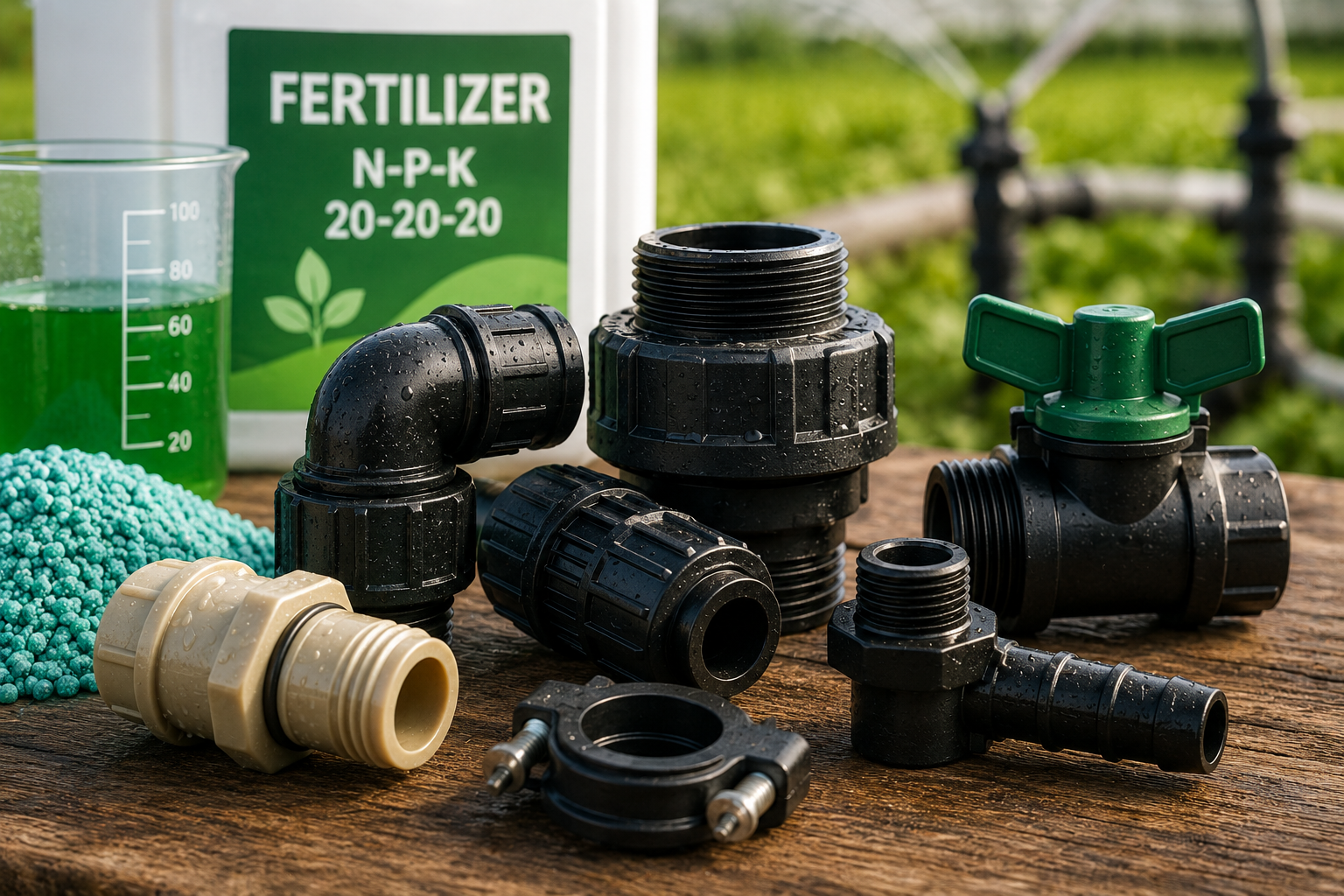
Fertilizer exposure can be rough on plastic parts. A component may look strong during assembly, pass early testing, and still crack, swell, leak, or weaken after repeated contact with agricultural chemicals. That is why sourcing chemical resistant plastic parts for fertilizer requires more than picking a resin that “usually works” and calling it a day.
For agricultural equipment and irrigation systems, chemical resistance is not just a material property. It is a full design conversation. Resin choice matters, but so do stress points, wall thickness, sealing geometry, UV exposure, temperature, pressure cycling, and how the part is installed in the field.
This guide explains what engineering and sourcing teams should watch for when designing or specifying fertilizer-resistant molded parts, especially for long-term agricultural plastic solutions.
Why Fertilizer Exposure Changes the Design Conversation
Fertilizers and nutrient blends can vary widely in chemistry, concentration, and exposure conditions. Some parts may only see occasional splash or residue. Others may be exposed to liquid fertilizer, fertigation systems, treated water, or cleaning agents repeatedly during operation.
The challenge is that fertilizer exposure rarely happens alone. In the field, chemicals are often combined with heat, UV, moisture, pressure, vibration, and mechanical load. That stacked environment is where failures become more likely. A plastic part might tolerate fertilizer contact in a relaxed condition, but crack when the same exposure happens around a threaded feature, clamp point, or stressed sealing surface.
That is why chemical resistance should be evaluated alongside part design and real use conditions, not as an isolated checkbox.
Material Choice: Start With the Actual Exposure
Material selection for fertilizer applications should begin with the specific exposure profile. A generic request for “chemical resistant plastic” leaves too much room for assumptions. The better approach is to document what the part will contact, how often, and under what conditions.
Important exposure details include:
- Type of fertilizer or nutrient blend
- Concentration or dilution level
- Exposure type, such as splash, wipe, residue, vapor, or immersion
- Exposure frequency and duration
- Temperature during exposure
- Whether the part is under load during exposure
These details help determine whether a material is appropriate for the application. They also help avoid over-specifying a resin that adds cost without meaningful performance benefit. For a broader comparison of resin properties, Hansen’s plastic injection molding materials guide can help frame chemical resistance, temperature, impact, cost, and appearance tradeoffs.
Environmental Stress Cracking: The Big Risk to Watch
One of the most important risks in fertilizer-exposed plastic parts is environmental stress cracking. This happens when chemical exposure and mechanical stress combine to create cracks over time. The annoying part is that the material may seem compatible at first, and the design may seem strong enough at first, but together they create a slow little betrayal machine.
Stress cracking often starts near features where load concentrates, such as:
- Threaded connections
- Barbed fittings
- Snap fits and clips
- Clamp areas
- Sharp corners
- Bosses and fastener locations
- Thin-to-thick wall transitions
The fix is not always “choose a stronger plastic.” In many cases, the better solution is to reduce stress concentration through smarter geometry, improve wall transitions, adjust assembly torque, or change how the part is supported in the assembly.
Design Geometry Matters as Much as Resin
Good material selection can be wasted by poor geometry. If a component has sharp internal corners, unsupported bosses, overly thin sections, or abrupt wall transitions, stress will collect in predictable places. Add fertilizer exposure, and those areas become failure candidates.
Design strategies that help improve chemical-exposed parts include using generous radii where possible, avoiding unnecessary sharp corners, supporting threaded or fastened areas, and keeping wall thickness as consistent as the part allows. Ribs can add stiffness without creating heavy wall sections, but they need to be designed carefully to avoid sink, warpage, and stress concentration.
This is where early injection mold design review matters. A DFM review can identify features that may mold poorly, trap stress, or become weak points under chemical exposure.
Sealing Surfaces and Leak Risk
Many fertilizer-related components are part of fluid systems, which means sealing performance matters. A part may be chemically resistant but still fail the application if it warps, creeps, flashes at a sealing surface, or loses dimensional stability over time.
For sealing applications, define the full interface. Is the seal made with an O-ring, gasket, tapered thread, compression fitting, or plastic-to-plastic contact? What pressure does it see? How often is it assembled or serviced? Is fertilizer exposure constant or intermittent?
Critical sealing details may include:
- Seal type and mating material
- Required compression or torque range
- Pressure cycling expectations
- Leak testing requirements
- Surface finish needs at sealing faces
- Parting line or flash sensitivity near the seal
If the component is used in irrigation, the same design concerns often overlap with drip irrigation plastic components, where stress points, UV exposure, sealing surfaces, and fit consistency all affect long-term reliability.
Temperature and UV Exposure Can Accelerate Failure
Agricultural parts exposed to fertilizer often live outdoors or near equipment. That means they may also face sunlight, heat, cold storage, and daily temperature cycling. These conditions can change material behavior over time.
Heat can increase creep and dimensional drift. Cold can reduce toughness and make impact failures more likely. UV exposure can reduce long-term strength if the material is not properly stabilized. When these factors combine with fertilizer exposure, parts may age faster than expected.
For outdoor applications, buyers should document:
- Full sun, partial shade, or protected use
- Expected service life
- High and low temperature ranges
- Seasonal storage conditions
- Whether appearance or color stability matters
Hansen’s guide to UV resistant plastic components for agriculture provides a useful companion checklist for specifying outdoor exposure and expected service life.
Fit and Assembly Requirements Should Be Defined Early
Chemical resistance alone does not guarantee assembly reliability. If a fitting is over-tightened, if a clamp creates too much localized stress, or if a part has inconsistent fit from run to run, chemical exposure can make those stress points worse over time.
For plastic parts for agricultural equipment, fit requirements should be documented before tooling begins. This includes critical-to-fit dimensions, torque ranges, mating part details, and whether the component will be removed and reinstalled during maintenance.
Part-to-part consistency is especially important when components are produced at higher volume. If one cavity in a multi-cavity tool produces a slightly different fit, the field problem may seem random even though the root cause is measurable. That is why fit, tooling, and injection molding quality control need to work together.
How Injection Molding Process Control Supports Chemical Resistance
Even when the resin and design are correct, processing can affect long-term performance. Poor material drying, excessive heat history, unstable packing, or inconsistent cooling can create internal stress or dimensional variation. Those hidden issues may not show up immediately, but they can become important once the part is exposed to fertilizer and field conditions.
A stable plastic injection molding process helps protect part quality by controlling how the material fills, packs, cools, and ejects. For chemically exposed parts, that repeatability matters because weak spots, variation, and residual stress can all affect durability.
Strong molding programs align:
- Material handling and drying requirements
- Process window and packing strategy
- Cooling and warpage control
- Inspection of critical-to-fit features
- Documentation for material lots and production runs
In plain English: the part needs to be made consistently, not just made once successfully.
What to Include in an RFQ for Fertilizer-Resistant Plastic Parts
To get better recommendations and more realistic quotes, provide the supplier with a clear application profile. You do not need a 40-page document that looks like it escaped a compliance dungeon. A focused checklist is enough.
- Part function and failure consequence
- CAD files and drawing revision
- Fertilizer or chemical exposure list
- Concentration, exposure type, and frequency
- Operating and storage temperature range
- Outdoor UV exposure and expected service life
- Pressure, load, vibration, or impact requirements
- Seal type and mating interface details
- Assembly method, torque range, or clamp force
- Critical-to-fit and critical-to-function dimensions
- Annual volume and seasonality
- Packaging requirements to protect sealing or precision features
If the part is part of a broader agricultural equipment program, Hansen’s guide to custom plastic manufacturing for agriculture can help organize environmental, chemical, UV, impact, tolerance, and volume requirements before quoting.
Better Chemical Resistance Starts With Better Specifications
Designing chemical resistant plastic parts for fertilizer is not just about selecting a resin from a compatibility chart. It requires understanding how fertilizer exposure interacts with stress, heat, UV, sealing geometry, assembly force, and long-term use.
When those details are defined early, suppliers can recommend better material options, identify design risks, and build a molding process that supports repeatable performance. That means fewer cracks, fewer leaks, fewer field failures, and fewer emergency explanations that start with “Well, technically…”
If your team is sourcing fertilizer-resistant molded components, Hansen Plastics can help evaluate material selection, part design, tooling strategy, and production requirements. Explore Hansen’s agricultural injection molding capabilities or learn more about plastic injection molding support for chemically exposed parts.