



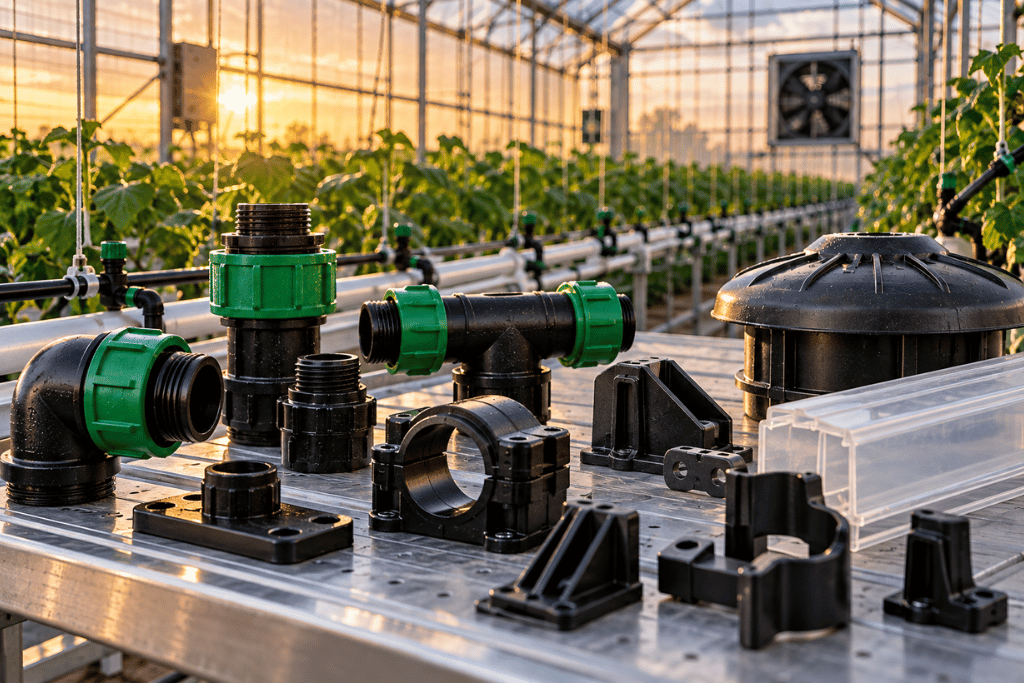
Winter retrofit projects are a practical opportunity to improve greenhouse systems before the next heavy production cycle begins. When irrigation layouts, mounting points, covers, housings, brackets, or fittings have caused issues during the season, the slower planning window is the right time to make improvements instead of dragging the same problems into another year like a sad little maintenance suitcase.
For greenhouse operations and agricultural OEMs, plastic greenhouse components need to do more than fit once during installation. They need to stay reliable through moisture, humidity, cleaning cycles, UV exposure, temperature shifts, repeated handling, and ongoing maintenance. That makes material selection, part design, fit consistency, and installation friendliness especially important during retrofit planning.
This guide explains how to evaluate and design plastic greenhouse components for winter retrofit projects, with a focus on fit, finish, UV performance, moisture exposure, and long-term usability.
Why Winter Is a Smart Time for Greenhouse Retrofits
Greenhouse systems are often upgraded during slower periods because teams can finally evaluate what worked, what failed, and what made daily maintenance harder than it needed to be. Instead of reacting to leaks, cracked fittings, warped covers, or difficult-to-install parts during peak operation, winter planning gives teams time to review components more intentionally.
A good retrofit plan should start with field feedback. Which parts were hard to install? Which components leaked or loosened? Which surfaces showed cracking, discoloration, or wear? Which assemblies took too long to service? These details help determine whether the solution requires a new material, a design adjustment, better tolerances, or a more repeatable molding process.
For agriculture-focused programs, Hansen’s agricultural injection molding capabilities support molded components that need to perform in environments with moisture, chemical exposure, UV, and repeated use.
Start With Fit: The Retrofit Detail That Saves Labor
Fit is one of the biggest drivers of retrofit success. A component that is slightly too tight can slow installation or create stress during assembly. A component that is too loose can lead to leaks, misalignment, vibration, or early failure. In greenhouse systems, where many parts are installed across repeated rows, benches, irrigation lines, and equipment interfaces, small fit problems multiply quickly.
For custom plastic greenhouse components, fit requirements should be documented before quoting or tooling changes begin. The team should define whether the part needs to seal, snap, align, clamp, mount, protect, or support another component.
Important fit details may include:
- mating part dimensions and tolerances
- installation force or torque expectations
- seal type, compression, or gasket requirements
- mounting hole locations and alignment needs
- snap-fit or clip retention requirements
- clearance around tubing, wires, frames, or moving parts
When fit is defined early, the molding partner can identify critical dimensions and build the quality plan around the features that actually protect assembly performance.
Finish and Surface Quality Matter in Greenhouse Environments
Surface finish is not only about appearance. In greenhouse applications, finish can affect cleaning, handling, moisture retention, sealing, and long-term part performance. A rough or poorly controlled surface may collect residue. A damaged sealing face can create leaks. A cosmetic surface that degrades under UV or chemical exposure can make equipment look older than it is.
For customer-facing or frequently handled parts, finish requirements should be clear. Define whether the component needs a specific texture, color, gloss level, or surface smoothness. If the part contacts a seal or gasket, that surface should be treated as functional, not decorative.
Finish decisions also connect to injection mold design. Gate location, parting lines, texture, venting, and ejection strategy can all influence the final surface. During retrofit planning, reviewing these details before tooling begins can prevent avoidable cosmetic and functional issues.
UV Exposure Still Matters Inside Greenhouses
It is tempting to think UV exposure is only a concern for outdoor field components, but greenhouse parts can still see meaningful light exposure depending on structure design, covering material, location, and how long the component is expected to remain in service.
UV exposure can contribute to brittleness, fading, chalking, and cracking over time. Parts near rooflines, vents, doors, sidewalls, or high-light areas may need better UV performance than components installed in shaded or protected zones.
When specifying greenhouse components, document:
- whether the part is in direct or filtered light
- expected service life
- whether color stability matters
- whether UV exposure combines with heat or chemicals
- whether the part must remain flexible or impact resistant over time
For parts with meaningful light exposure, Hansen’s guide to UV resistant plastic components for agriculture can help teams document outdoor and semi-outdoor performance requirements more clearly.
Moisture and Humidity Can Affect Long-Term Performance
Greenhouse environments are humid by design. Moisture, condensation, cleaning cycles, nutrient solutions, and irrigation overspray can all affect plastic components over time. Some materials may absorb moisture, shift dimensionally, lose stiffness, or behave differently under constant humidity.
For retrofit projects, teams should consider where moisture collects and how parts are cleaned. Components that trap water or residue may become harder to maintain. Parts that sit under constant compression in warm, wet environments may need additional review for creep, seal retention, and dimensional stability.
Moisture-related design questions include:
- Will the part be exposed to constant humidity?
- Will it contact water, nutrient solution, or cleaning chemicals?
- Does the geometry trap liquid or debris?
- Does the part need drainage or easier wipe-down surfaces?
- Will the component be removed and reinstalled during cleaning?
These details can guide both material selection and part geometry, especially for components tied to irrigation, sealing, or repeated maintenance.
Installation Friendliness Should Be Designed In
A retrofit part can be technically correct and still be a pain in the ass to install. That matters because greenhouse retrofit work is often repeated across many zones, rows, or assemblies. If each part takes extra effort, requires awkward alignment, or needs too much force, labor costs rise and installation quality becomes less consistent.
Installation-friendly design may include clear orientation features, forgiving lead-ins, accessible fastener points, reduced part count, easier snap engagement, or improved clearance for tools and hands. Small design improvements can make a big difference when the same component is installed hundreds or thousands of times.
If a part connects to irrigation, the same thinking applies to greenhouse irrigation components. Fit consistency helps prevent leaks, misalignment, and frustration during assembly.
Material Selection Should Match Greenhouse Conditions
The best resin for a greenhouse retrofit depends on the part’s function. A structural bracket, protective cover, irrigation fitting, sensor housing, and clip do not all need the same material properties. Overbuilding every component can increase cost unnecessarily. Underbuilding the wrong part can lead to failures that create downtime and replacement work.
Greenhouse material selection may need to consider:
- moisture and humidity exposure
- temperature range and heat buildup
- UV exposure level
- chemical contact from nutrients or cleaners
- impact during installation or maintenance
- creep under sustained load
- dimensional stability for tight fit areas
For teams comparing resin options, Hansen’s plastic injection molding materials guide can help frame material tradeoffs around chemical resistance, temperature, impact, cost, and appearance.
Design for Cleaning and Maintenance
Greenhouse parts often need to survive cleaning, wipe-downs, spray exposure, and repeated inspection. If the part design creates hard-to-clean pockets or fragile features, maintenance becomes more difficult over time.
During retrofit planning, look for ways to simplify geometry without sacrificing function. Smooth transitions, accessible surfaces, fewer unnecessary recesses, and protected sealing areas can help make components easier to maintain.
This is especially helpful for components exposed to nutrient residue or cleaning agents. If the part may contact fertilizers, chemical compatibility should be documented. Hansen’s guide to chemical resistant plastic parts for fertilizer provides useful considerations for material choice, stress cracking risks, sealing, UV, and fit requirements.
Repeatability Matters When Retrofitting at Scale
One replacement part is easy to evaluate. A retrofit program with repeated parts across many assemblies requires consistency. If parts vary too much, installers may see random fit problems, alignment issues, or sealing failures. That variation can make a retrofit project feel messy even when the design intent is solid.
Plastic injection molding supports repeatability when the tooling, material, process, and quality checks are aligned. For retrofit programs, that repeatability helps parts install consistently and perform predictably across the entire greenhouse system.
If fit is critical, the quality plan should focus on critical-to-fit features. That may include hole locations, sealing dimensions, clip geometry, snap features, tube interfaces, or mounting surfaces.
What to Document Before Quoting Greenhouse Retrofit Components
A strong RFQ helps the supplier recommend the right material, tooling, and production approach. For greenhouse retrofit projects, include both the part file and the real installation context.
- part function and failure consequence
- CAD files and drawing revision
- where the part is installed in the greenhouse
- mating components and assembly method
- critical-to-fit dimensions and tolerance priorities
- UV exposure and expected service life
- temperature, humidity, and moisture exposure
- chemical exposure from nutrients, fertilizers, or cleaners
- installation method, tools, torque, or insertion force
- cleaning and maintenance requirements
- annual volume or retrofit quantity
- timeline for installation before the next season
This information helps turn a vague retrofit request into a production plan that supports reliable fit and long-term performance.
Better Retrofit Components Start With Better Planning
Greenhouse retrofit projects are an opportunity to fix the small issues that slow installation, increase maintenance, or reduce system reliability. By focusing on fit, finish, UV exposure, moisture, material selection, and installation friendliness, teams can design plastic components that support smoother upgrades and more predictable performance.
The strongest retrofit plans start early, document real conditions, and involve the molding partner before the design is treated as final. That gives the team time to adjust geometry, select materials, review tooling needs, and plan production before the next season starts breathing down everyone’s neck like an impatient greenhouse dragon.
If your team is planning custom plastic greenhouse components for a retrofit project, Hansen Plastics can help review material options, fit requirements, tooling strategy, and production timing. Explore Hansen’s agricultural injection molding capabilities or learn more about custom plastic injection molding support for reliable production parts.